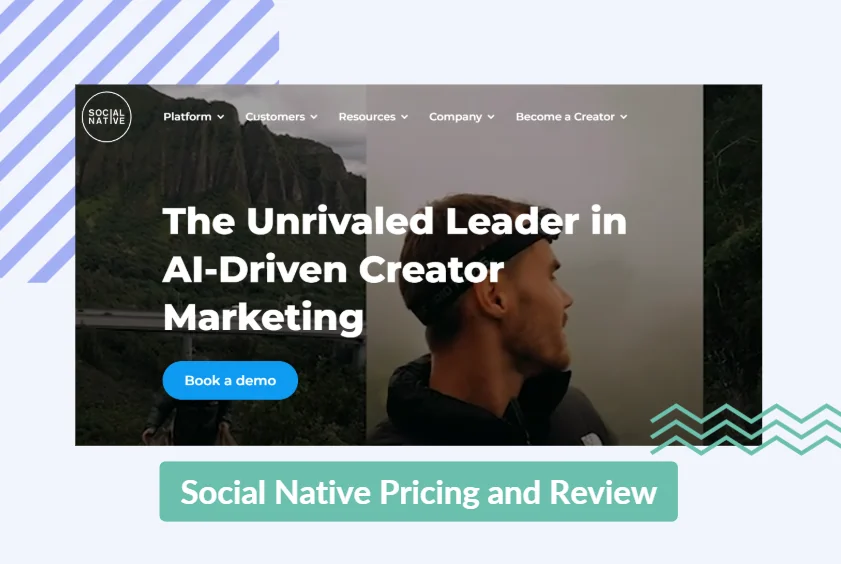
Social Native Pricing & Review 2026: Features, Costs & Verdict
Social Native pricing isn't public — it's quote-based, with no fixed tiers, no free plan, and a setup that typically assumes a multi-month commitment. So if you came looking for a clean monthly number, the honest answer is: you'll need to book a call first.
In this review, we cover Social Native's pricing model, standout features, real user feedback, and whether it's worth it for your team.
If you're a brand running or scaling a creator program — especially one that leans heavily on visual content and UGC — this breakdown is for you.
Best for: Mid-market and enterprise brands that need UGC at scale plus full-service campaign support
Starting price: Quote-based (no public pricing, no free plan)
Free trial: No
G2 rating: 5.0/5 — but from only 3 reviews, so take it as a small sample
Our verdict: A strong full-service UGC and influencer hybrid for enterprise retailers, but the custom pricing, minimum commitments, and enterprise focus make it a poor fit for smaller or self-serve teams.
What Is Social Native?
Social Native is a UGC and creator content platform that helps brands source, curate, secure rights to, and distribute visual content across ecommerce, paid ads, social, email, and even in-store signage. It's the result of Social Native (founded 2017) acquiring Olapic (founded 2010) in 2021 — combining Olapic's visual content curation legacy with Social Native's creator network and AI tooling.
The platform leans full-service: it handles creator discovery, content review, payments, rights management, and post-campaign reporting, backed by a creator community the company puts at around 3 million. It's built for mid-market and enterprise brands — think Adidas, L'Oréal, Dr. Martens, and IKEA — not solo founders or early-stage D2C teams.
Social Native Key Features
Full-service UGC sourcing and production. You brief the platform and its team sources creators, manages content production, and handles usage rights. This is the core strength — it offloads the operational lift of getting on-brand visual content at volume.
AI content tooling. Social Native uses AI to curate UGC and even transform still images into short-form video, and the company claims it eliminates around 90% of the manual work in UGC management.
Automated rights management. Built-in tools clear usage rights so you can legally repurpose creator and customer content across channels. For enterprise brands juggling compliance, this is a real operational advantage over manual rights tracking.
Multi-channel content activation. Content can be pushed to ecommerce product pages, paid social ads, email, organic social, and in-store displays. This is the Olapic DNA — turning UGC into shoppable, on-site widgets and galleries, not just social posts.
Exclusive platform partnerships and integrations. Social Native has exclusive partnerships with Meta and TikTok, plus a Shopify integration for ecommerce. Historically the content sourcing skewed toward Instagram and Twitter via mentions and tags; the Meta and TikTok ties now make short-form video a bigger part of the offering.
Social Native Pricing
Social Native uses fully custom, quote-based pricing — there are no published plans or tiers, and you'll need an introductory meeting to get a number.
Custom Enterprise — Quote-based
Pricing is built per brand after a discovery call, and it generally aligns with mid-market to enterprise budgets. There's no free plan and no self-serve entry point. Public signals suggest a custom plan typically assumes a minimum campaign duration of around 6 months and roughly 15–20 creators per month, so this isn't a tool you dip into for a one-off campaign.
Because everything is bespoke, your final cost depends on scope — UGC sourcing volume, whether you need custom creator content production, the level of full-service management, and which channels you're activating across.
Watch for:
The lack of transparent pricing is itself the cost to factor in. You can't budget against a number before talking to sales, and the minimum-commitment structure means you're signing up for an ongoing relationship, not a month-to-month tool. For smaller brands, that alone is usually a dealbreaker.
Social Native Pros & Cons
Pros
Genuinely full-service. If you don't have an in-house team to run discovery, content review, payments, and reporting, Social Native does the heavy lifting for you. That's its biggest draw for lean marketing teams at larger brands.
Strong UGC and rights workflow. The combination of content sourcing, AI curation, and automated rights clearance is well-suited to brands producing visual content at scale across multiple channels.
Exclusive Meta and TikTok partnerships. These give it credibility for short-form video and paid social activation that many UGC tools can't match.
Multi-channel activation built in. Pushing UGC to ecommerce pages like Shopify, ads, email, and in-store is baked into the platform — a holdover strength from the Olapic side.
Cons
No transparent pricing and no free plan. You can't evaluate cost without a sales call, and there's no trial or entry tier to test the waters.
Minimum commitments. The typical 6-month duration and 15–20 creators/month floor make it inaccessible for small brands or anyone wanting flexibility.
Enterprise focus and implementation complexity. It's built for brands with the scale and resources to implement it. Smaller teams can find it heavy and over-engineered for their needs.
Limited flexibility for niche campaigns. Reviewers note the platform can feel rigid when you want to run highly specific or unconventional campaigns.
What Social Native Users Say
Social Native holds a 5.0/5 on G2 — but that's based on only three reviews, so it's a flattering rating from a very small sample rather than a deep, battle-tested consensus. Treat it as directional, not definitive.
Where users are positive, they consistently point to ease of use, the AI automation that streamlines content production, and the quality of the brand campaigns and collaborations.
On the downside, even within those positive reviews, users flag that the platform could be more user-friendly and that it feels rigid for highly niche campaigns. One reviewer noted the platform is "a bit rigid in flexibility" for very specific campaign needs. Combined with the enterprise-heavy positioning, the broader pattern is clear: it shines for high-volume content operations and gets clunky for teams wanting granular control.
Who Is Social Native Best For?
Social Native is best for mid-market and enterprise brands — particularly brands in fashion, furniture, beauty, and consumer goods — that produce a lot of visual content and want a partner to handle UGC sourcing, rights, and multi-channel activation without building the workflow in-house. If you're a brand like Dr. Martens or IKEA with real content volume and a budget to match, it's a logical fit.
It starts to fall short for smaller D2C brands, anyone wanting self-serve control, or teams that need the full influencer lifecycle — advanced discovery, creator CRM, automated outreach, and granular affiliate or revenue tracking. Social Native is content-first, not a complete influencer-management system, so those teams often end up supplementing it with other tools.
On budget: it makes sense when you're committing to an ongoing, multi-month content program at scale. If your spend is modest or your needs are occasional, the minimum commitments and quote-based pricing mean there are better-value options.
Is Social Native Worth It?
For the right brand, yes. If you're an enterprise retailer drowning in the operational work of sourcing, clearing, and distributing visual content — and you want a partner to own that — Social Native delivers, and the AI tooling and exclusive Meta/TikTok ties are real advantages.
But if you're a smaller brand, want transparent pricing, need flexibility, or are looking for a true end-to-end influencer platform rather than a UGC content engine, it'll feel like overkill — and you won't even know what it costs until you sit through a sales call. For those teams, it's worth looking elsewhere.
Final Thoughts
Social Native does one thing very well: it turns UGC and creator content into a scalable, multi-channel content operation for big brands, with strong rights management and AI tooling layered on top. The catch is the opacity and commitment — quote-based pricing, no free plan, and a multi-month minimum that locks out smaller or more flexible teams.
If the campaign-management overhead is exactly what you're trying to avoid, there's a different model worth considering. Instead of managing sourcing, contracts, and content production, Creator Hero lets creators sell your products directly through commission-based storefronts — no upfront campaign spend, with affiliate commissions in the 20–50% range and a directory of 55,000+ brands. Plans are free to start, then $19/mo (Pro) or $65/mo (Premium).
Let the creators do the selling for you, so you can focus on developing new products and scaling your brand. Explore Creator Hero for brands or book a free demo to see how it works.
FAQs
How much does Social Native cost?
Social Native uses custom, quote-based pricing with no public tiers or free plan. Costs are built per brand after a discovery call and generally fit mid-market to enterprise budgets, often with a minimum commitment of around 6 months.
Does Social Native have a free trial?
No. There's no free trial and no free plan — you'll need to book a meeting with their team to get a custom quote before you can use the platform.
Is Social Native worth it for small brands?
Generally no. The enterprise focus, quote-based pricing, and minimum commitments (roughly 15–20 creators/month over several months) make it a poor fit for small or early-stage brands. Smaller teams usually find better value in self-serve tools.
What is Social Native best for?
It's best for mid-market and enterprise brands that need UGC and creator content at scale, plus full-service support for sourcing, rights management, and multi-channel distribution across ecommerce, ads, social, and email.
What's a good alternative to Social Native?
For brands that want creator-driven sales without the campaign-management lift, Creator Hero offers a commission-based storefront model. Other alternatives depend on your needs — discovery-heavy tools, full influencer CRMs, or other UGC platforms each serve different use cases.
Related Posts
The incredible power of team collaboration is evident in the remarkable outcomes it can achieve
Influur pricing explained: no brand subscription, pay-as-you-go fees, real pros and cons, and our verdict on whether this creator marketplace is worth it in 2026.
Tagbox looks cheap at $19/month — but the feature most brands actually need is hidden behind an Enterprise quote. Here's the full pricing breakdown and our honest verdict.
Word on the Block charges no subscription — but its pricing page never tells you the fee. Here's what the model actually costs brands, what's included, and our honest verdict.
Build your own business without having to manage all the operational aspects of an e-commerce. Focus on creating content, driving sales and maximise your earnings!


.svg)


%201.png)



_logo.svg.png)


