Keymailer Pricing & Review 2026: Features, Costs & Verdict
Keymailer pricing starts free and runs from $24.99/month for a single game up to $299/month for a multi-title catalog — but that's only the software layer. Any actual promotion starts at $249 on top, and that gap between plan price and campaign cost is the thing most publishers miss.
There's also a structural change worth knowing before you go looking: Keymailer's publisher login and pricing have moved to Partnier, the parent ecosystem. The plans are the same product, but keymailer.co now points you to partnier.com to buy.
In this review, we cover Keymailer's pricing tiers, standout features, real user feedback, and whether it's worth it for your team.
Quick Summary
Best for: Game publishers and indie devs distributing keys to gaming creators at scale
Starting price: Free, with paid plans from $24.99/month per game
Free trial: Yes — a permanent free plan, no card required
G2 rating: No reviews yet; creator-side sentiment on Trustpilot is mixed
Our verdict: The deepest gaming creator network available and a genuinely usable free tier, but the headline price covers one game and real promotion is a separate line item.
What Is Keymailer?
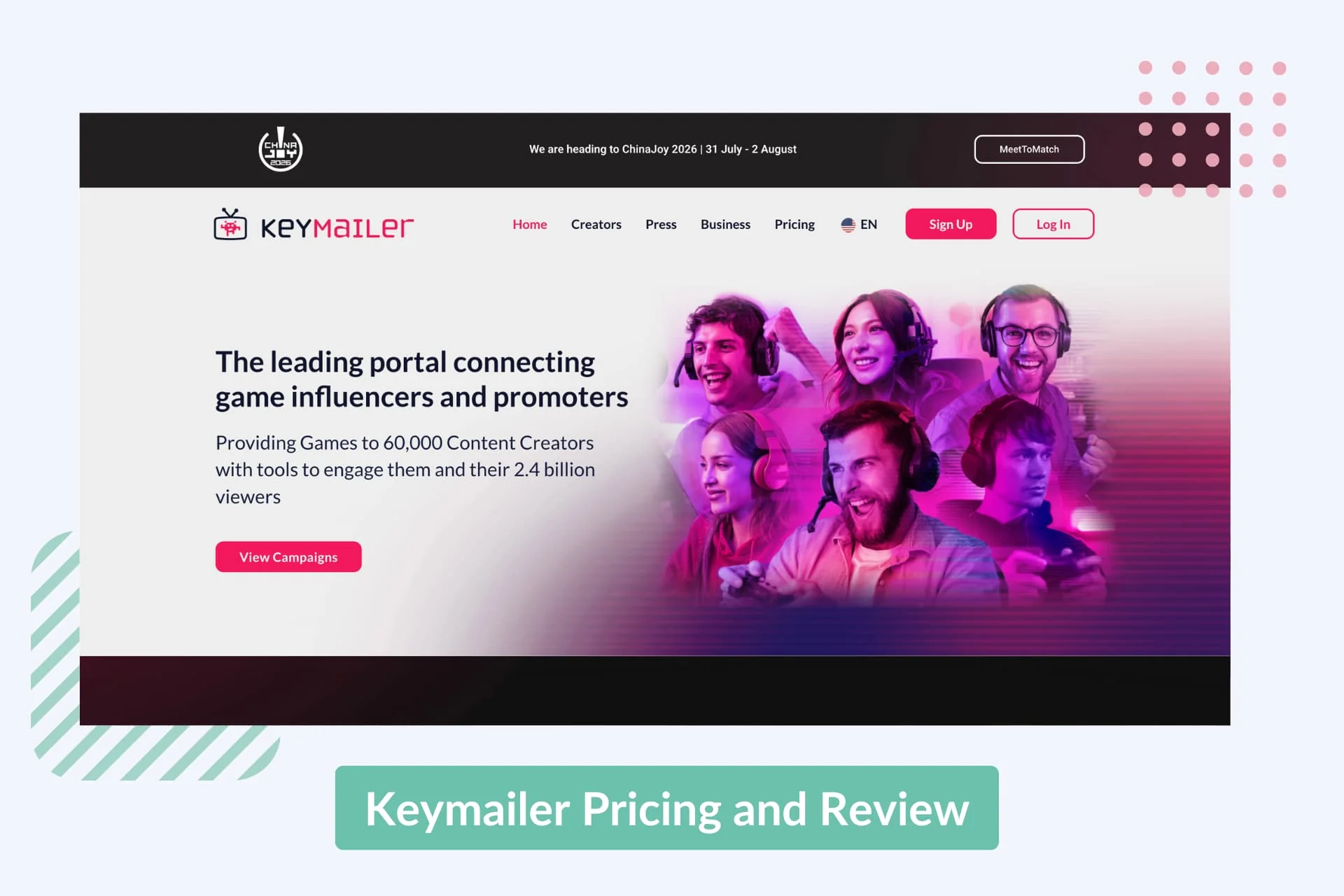
Keymailer is an influencer marketing and key distribution platform built specifically for video games. Publishers list a game, creators browse and request keys, and the platform handles vetting, code distribution, anti-fraud checks, and coverage tracking.
It's now one product inside Partnier, a wider game marketing ecosystem that also includes Game.Press for press outreach, Playtester.Net for playtesting, and Just Influencers for paid creator campaigns. The network spans 60,000+ vetted influencers with a combined 2.4 billion followers and 2,500+ accredited press outlets, with roughly 20,000 organizations on the platform including Xbox Game Studios, Bethesda, Warner Bros, Konami, Bandai Namco, Team17, tinyBuild, and Coffee Stain.
Keymailer Key Features
Inbound creator discovery
This is the core mechanic and the reason publishers use it. Rather than cold-outreaching streamers, you list your game and creators come to you — plus your title gets recommended to influencers who've covered similar games, working roughly like Steam's discovery queue for creators.
The limitation is that inbound only works if creators want your game. A title with no hook won't generate requests no matter which plan you're on.
Creator vetting and scoring
Every creator carries a set of signals: a Creator Reliability Score estimating likelihood of actually producing content, declared intent (maybe/probably/definitely), Predicted Views, True Location, Channel Focus, and a Gamer Score benchmarked against a database of 200,000 games. VR Verified and Mobile Verified flags exist too.
For a publisher deciding who gets a limited pool of keys, this is genuinely more decision-useful than follower counts.
Anti-fraud and code security
An encrypted code vault, throttled distribution with 2FA, Steam activation tracking to catch keys being resold, daily network-wide bot screening, and a full-time compliance officer. Key resale to grey-market sites is a real revenue leak for indies, and this is the strongest practical argument for using a platform instead of a spreadsheet.
Content monitoring and AI analysis
Tracks coverage across YouTube, Twitch, TikTok, Instagram, and Facebook Gaming, including content from creators you never sent a code to. Higher tiers add AI content analysis, stream snapshots in case you miss a live broadcast, and automated competitor comparison.
A campaign CRM they describe as free
Their own pricing page pitches the campaign management app as being like GRIN and Aspire, but free. On the free tier you get the full CRM, code distribution, and coverage tracking for your own contacts — the paid gate is on network access, not tooling.
Keymailer Pricing
Pricing splits into four plan tiers, then Boosts for promotion, then Subscriptions that bundle everything. Plans are priced per game, with a discounted rate for catalogs of five or more.
Free Plan — $0
Full campaign management, CRM, anti-fraud, code distribution, and content tracking — but only for creators and press you already have. Requests from the Keymailer network are capped at 10 per month. It's a real product, not a demo, and it's the right starting point for a solo dev with an existing contact list.
Base Plan — $24.99/month (1 game) or $99/month (5+ games)
Unlocks the thing you actually came for: unlimited organic discovery through the Keymailer and Game.Press portals, influencer recommendations, total content tracking, and stream alerts. For most indie developers this is the working tier.
Insight Plan — $49/month (1 game) or $199/month (5+ games)
Adds AI content analysis, stream snapshots, and automated competitor analysis. Worth it if you're reporting to stakeholders who want coverage quality assessed rather than just counted.
Program Plan — $99/month (1 game) or $299/month (5+ games)
Adds creator programs for long-term loyalty, back-catalog promotion, CreatorConnect for IRL events, Nova Game Expo access, the playtester app, and contract signing. Built for publishers running continuous creator relationships rather than one launch.
Fair use caps the 5+ pricing at 20 active games; beyond that you're into enterprise territory.
Boosts — from $249
Promotion bundles: newsletter placements to the 60,000-influencer list, discover-page ads, native social ads across a 45,000-follower audience, outreach blasts, scouting outside the network, and Steam event inclusions. Bundling saves up to 50% versus buying promotions individually.
Subscriptions — quote-based
Plans plus Boosts plus services on a launch roadmap, with runways of 9+ months, 6 months, 3 months, or quick launch. Up to 25% off buying the components separately.
Hidden costs worth flagging:
- The $24.99 headline is a one-game price. A publisher with a modest catalog is at $99–$299/month before any promotion.
- Plans don't include promotion. Portal ads, newsletter placements, and social posts sit in Boosts at $249+. It's easy to buy a plan and wonder why nothing happened.
- Managed services are priced separately: professional campaign management runs $749/month, press PR from $349, Asia outreach from $349, trailer production from $149.
- Paid creator work is its own line: micro-payment challenges from $449, best-price bid campaigns from $749, and negotiated sponsored content at $99 per contracted influencer with a five-influencer minimum — so roughly $495 in fees before creator payments.
- The free tier's 10-request monthly cap is the real upgrade trigger, and it's buried in a comparison-table footnote rather than stated plainly.
One point in their favour: Keymailer publishes a price-match guarantee, promising to beat any comparable service by 10%.
Keymailer Pros & Cons
Pros
- The largest gaming creator network in the category. 60,000+ opted-in, accredited influencers who actively browse for games to cover. Nothing else in games marketing has this depth of inbound.
- The free plan is genuinely usable. Full CRM, code vault, and coverage tracking at zero cost puts it well ahead of tools that gate basic functionality.
- Anti-fraud infrastructure that addresses a real loss. Activation tracking, throttling, and daily bot screening directly target grey-market key resale.
- Vetting signals beat follower counts. Reliability scores, declared intent, predicted views, and genre focus are the metrics that actually predict whether a key turns into coverage.
- Entry pricing is very low for the category. $24.99/month against $2,000/month platforms like GRIN and Aspire, even accounting for the different job they do.
Cons
- The pricing architecture is confusing. Plans, Boosts, Subscriptions, services, and paid collaborations are five separate pricing models on one page, and the total cost of a real launch isn't obvious from the sticker.
- The Keymailer brand now sits under Partnier. Searching "Keymailer pricing" lands you on a page that redirects to another domain. Expect some friction until the rebrand settles.
- Creator-side sentiment has slipped. Reported frustrations from established creators about rejected requests matter to publishers, because inbound quality depends on creators staying engaged.
- No affiliate tracking or payout management. Keymailer is built around key distribution and coverage, not revenue attribution. Connecting influencer activity to actual sales requires a separate tool.
- Onboarding can be slow. At least one indie developer reported waiting a week with no response to a membership application.
What Keymailer Users Say
Keymailer's G2 profile is managed by the company but carries no reviews yet, so there's no aggregate score to anchor on. The available sentiment splits sharply along publisher and creator lines, and that split is the most useful thing in this section.
Publisher-side feedback is positive and consistent. Developers on itch.io recommend it as the safer route for key distribution, with one noting it's "a lot safer to go through vetted platforms" while still advising publishers to vet requesters themselves. Testimonials on Keymailer's own site credit it with driving the creator coverage behind successful launches.
Creator-side sentiment on Trustpilot, across a small sample of around 20 reviewers, is considerably rougher. A gaming YouTuber with 68,000 subscribers and eight years on the platform described a decline from promising to "practically useless," citing requests rejected for titles they'd clearly qualify for — then receiving the same key directly from the publisher.
Two allegations from that thread are worth naming without treating as established fact: that the platform has reported keys as redeemed with no content produced, harming creator standing with developers, and that some games appear on the portal without active publisher participation, as a way to demonstrate creator demand when pitching paid packages. Both are unverified individual accounts. For a publisher, though, souring creator sentiment is a leading indicator of thinner, lower-quality inbound over time.
Who Is Keymailer Best For?
Keymailer suits game publishers and developers whose primary problem is getting keys into the right hands safely. If you're launching a title and want streamer and YouTube coverage without cold outreach, the network is the asset and $24.99/month is a rounding error against a launch budget.
It fits indies particularly well because of the free tier. A solo developer with an existing press list can run a full campaign at zero cost and upgrade only when they need network access.
Multi-title publishers get real value from the Program Plan's creator loyalty tools and back-catalog promotion, which keeps older titles earning coverage during Steam sales rather than only at launch.
Where it stops working: teams that need influencer activity tied to revenue. Keymailer measures coverage, not conversions, and publishers who need wishlist and purchase attribution will end up pairing it with something else. It's also the wrong tool for any brand outside games — the creator database, campaign templates, and reporting are all built around game launches.
Is Keymailer Worth It?
For game publishers, yes, and the free plan makes that an easy thing to establish for yourself. The network genuinely is the biggest in gaming, the anti-fraud tooling addresses a measurable revenue leak, and the entry pricing is low enough that the software layer is rarely the question.
The honest caution is on total cost rather than value. Plans are cheap; visibility is not. A realistic launch — Base Plan, one Boost, and a modest amount of managed support — lands well north of the $24.99 that shows up in search results. Budget from the campaign backwards, not from the plan price forwards, and price a Subscription bundle against the à la carte total before committing.
Keymailer Alternatives
If Keymailer isn't the right fit — whether the gap is revenue attribution, pricing clarity, or wanting more managed support — here are five alternatives worth a look.
Lurkit
The closest direct competitor: a Swedish key distribution and creator platform with campaign management, coverage tracking, and a creator marketplace. Indie plans start around $89/month, with discounts up to 70% in the first year for qualifying developers. You'd pick it over Keymailer for a cleaner single-price structure without the Plans-plus-Boosts layering.
Woovit
Key distribution with a free tier and paid plans unlocking unlimited campaigns across a game's lifecycle, plus flexible agency pricing. Smaller network than Keymailer, but the lifecycle-based rather than per-month model suits developers with long tails and irregular promotion needs.
Gamesight
Attribution-first influencer marketing for games, connecting creator activity to wishlists, installs, and purchases across Steam and console storefronts. Enterprise pricing. This is the answer to Keymailer's biggest gap: if you need to prove influencer spend drove revenue rather than views, Gamesight is built for exactly that.
Influencer Hero
An all-in-one influencer marketing platform with creator discovery across Instagram, TikTok and YouTube, an influencer CRM, automated outreach and follow-ups, campaign management, affiliate and gifting tracking, payments, and reporting. Pricing is demo-based. It's not a key distribution tool, so it's the right call in a narrower case: gaming hardware, peripheral, merch, and consumer brands in the games space, or publishers running paid creator campaigns who need affiliate tracking and creator payments in one system.
Terminals.io
A fully managed PR and key distribution service operated by Evolve PR, covering press outreach and coverage tracking on a vetted network built over a decade. Best when you'd rather buy an outcome than run a platform, and you have the launch budget to support it.
Final Thoughts
Keymailer does the specific job of games key distribution better than anything else available, and it prices the software honestly and low. The network depth, vetting signals, and anti-fraud tooling are all real advantages, and the free tier means you can evaluate it properly without a sales call. The caveats are that the sticker price covers one game, that promotion is a separate purchase starting at $249, and that the platform measures coverage rather than sales.
For consumer brands in and around gaming selling physical products, Creator Hero inverts that: creators sell through commission-based storefronts at 20–50%, so they earn when you earn and there's no upfront campaign spend. It won't distribute Steam keys, but if what you're moving is peripherals, merch, or any physical product, the incentive alignment is fundamentally different.
Let the creators do the selling for you, so you can focus on developing new products and scaling your brand. Explore Creator Hero for brands or book a free demo to see how it works.


.svg)


%201.png)


_logo.svg.png)


