Tagbox Pricing & Review 2026: Features, Costs & Verdict
Tagbox pricing starts free and runs from $19/month up to $79/month on annual billing, with anything involving UGC rights, API access, or white-labeling pushed into a custom Enterprise quote. That last part matters more than the sticker price, and we'll get to why.
In this review, we cover Tagbox's pricing tiers, standout features, real user feedback, and whether it's worth it for your team.
If you're a brand collecting customer photos, videos, and reviews and trying to figure out where to actually put them, this breakdown is for you.
Quick Summary
Best for: eCommerce and hospitality brands that already have customer content and want it on-site
Starting price: $0 (free plan), paid from $19/month
Free trial: Yes — 14 days, no card required
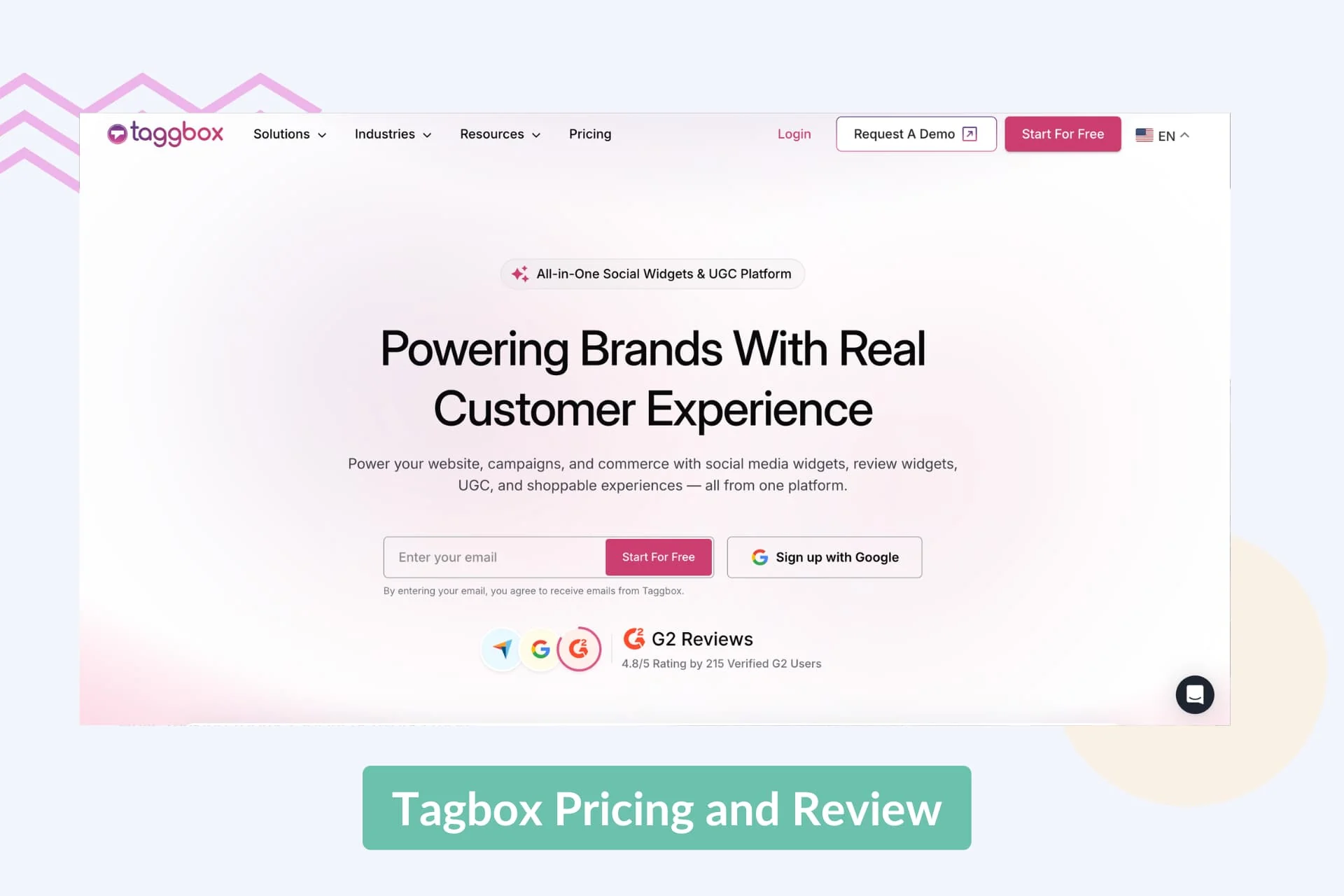
G2 rating: 4.8/5 (214 reviews)
Our verdict: Cheapest credible way to display UGC on your site, but the feature brands need most — rights management — is locked behind an Enterprise quote.
What Is Tagbox?
Tagbox (officially Taggbox, currently rebranding to Tagbox) is a UGC platform and social media aggregator founded in 2016. It pulls posts, photos, videos, and reviews from 15+ social platforms and 10+ review sites, then lets you embed that content on your website, in emails, on digital signage, or on live event screens.
The company reports 9,240+ brands using the platform and 93,000+ websites running its widgets, with clients including Bose Professional, The Leela, Shein, Oxfam, and Warner Bros. Its job is social proof and content display — not finding creators or running campaigns. Keep that distinction in mind for the rest of this review.
Tagbox Key Features
Social and review aggregation
Tagbox connects to Instagram, TikTok, YouTube, Facebook, LinkedIn, X, Pinterest, Threads, Bluesky, and more, plus review sources like Google, Yelp, Amazon, Tripadvisor, Etsy, and Booking.com. You build a "feed" per source or hashtag and embed it anywhere.
The catch is feed count. Free gets you 1, Starter 2, Growth 4, and Advanced 10 — so a brand running multiple hashtag campaigns plus review widgets hits the ceiling faster than expected.
Shoppable UGC galleries
You can tag products directly inside customer photos and videos, turning a gallery into a path to checkout. This unlocks on the Growth plan at $29/month annual, which is unusually cheap — most competitors treat shoppable UGC as an enterprise feature.
Moderation, tiered by plan
Free and Starter give you manual approval only. Automatic rule-based moderation starts at Growth, and AI moderation only appears on Advanced at $79/month annual. If you're pulling in hashtag content at volume, manual moderation on the cheap plans becomes a daily job for someone.
Widget customization and themes
Layouts, themes, custom CSS, CTA buttons, and custom posts are available across paid tiers, and reviewers consistently mention that embedding takes minutes with no developer. This is probably Tagbox's strongest practical advantage over heavier platforms.
Two separate products
Widgets (website and email embeds) and Display / Social Walls (events, venues, digital signage) are different product lines with different pricing pages. The widget plans below do not include social walls — that's a separate purchase.
Tagbox Pricing
Tagbox publishes its widget pricing openly, which is a point in its favor in a category where Flowbox and Bazaarvoice both hide behind a demo call. Annual billing saves up to 25%.
Free — $0/month
One feed, 500 monthly views, 500 stored posts, and a 4-day content refresh. You get 10+ review sources but a narrow social selection, manual moderation only, and one social publish per month. It's genuinely usable for a small site testing the concept, not a crippled demo.
Starter — $19/month
Two feeds, 10,000 monthly views, 15+ platforms, 5,000 stored posts, and updates every 2 hours. Adds ad-free widgets, email support, one collaborator, and 20 social publishes per month. The main constraint is moderation — still manual — and the 10K view cap, which a modest Shopify store clears in a month.
Growth — $29/month annual, $39/month monthly
Four feeds, 50,000 monthly views, 30,000 posts, and 30-minute updates. This is the first tier that makes sense for a D2C brand: it adds shoppable widgets, automatic moderation, a Wall of Love page, live chat support, two collaborators, and 50 social publishes per month.
Advanced — $79/month annual, $99/month monthly
Ten feeds, 1M monthly views, 100,000 posts, and 15-minute refreshes. Adds AI moderation, two dedicated X feeds and two TikTok feeds, four collaborators, 150 social publishes, and chat plus phone support. Built for higher-traffic sites running several campaigns at once.
Enterprise / Agency — custom quote
This is where UGC rights management, API access, white-labeling, localization, automatic product tagging, security assessment and DPA, and invoice billing live. No public number.
Hidden costs worth flagging:
- UGC rights management is Enterprise-only. If you want to legally repurpose a customer's Instagram post in a paid ad or on a product page, that permissions workflow is not on any published tier. For most brands, this is the whole point of a UGC tool.
- You're metered on views, not features. Traffic growth pushes you up a tier even if your feature needs haven't changed. Budgeting gets unpredictable as the site scales.
- API access is also Enterprise-only. One G2 reviewer specifically flagged not being told about API limitations before subscribing.
- Social Walls / Display is a separate purchase. Third-party listings put that product anywhere from roughly $49/month to four figures depending on event scale.
- No refunds on monthly plans. Annual plans allow refunds only in exceptional cases, and collected posts and widgets are deleted once your billing period ends.
Tagbox Pros & Cons
Pros
- Transparent, genuinely low entry pricing. $19 to $79/month in a category where Flowbox and Bazaarvoice won't quote you without a call, and Walls.io starts around $215/month.
- Shoppable galleries at $29/month. Product tagging inside customer content at that price is the best value in this list of features.
- Setup is fast and no-code. Reviewers across G2 and Capterra repeatedly describe embedding widgets in minutes, not days.
- Support is a consistent strength. 24/7 availability and fast response times come up over and over in reviews, including from users who switched from more expensive tools.
- Wide source coverage. Social plus review platforms in one tool means you're not running a separate reviews widget alongside your Instagram feed.
Cons
- Rights management is gated behind a custom quote. The single most legally important feature for brands repurposing customer content isn't purchasable at a published price.
- View caps create bill creep. 50,000 monthly views on Growth is not much for a store doing real traffic, and the jump to Advanced is a 2.7x price increase.
- Feed counts jump awkwardly. Growth gives 4 feeds, Advanced gives 10, and there's nothing in between if you need 6.
- Billing friction shows up in reviews. Multiple reviewers describe double-charging and slow resolution, and there are no refunds on monthly plans.
- It displays content, it doesn't create it. If you don't already have a steady stream of customer photos and videos, Tagbox has nothing to aggregate.
What Tagbox Users Say
Tagbox holds a 4.8/5 on G2 across 214 reviews and sits around 4.5/5 on Capterra. The praise clusters tightly around three things: how quickly widgets go live, how much control you get over themes and layouts, and how responsive support is.
One G2 reviewer explained they moved over from Flowbox because "the pricing didn't match the level of support or features" they were getting, and highlighted round-the-clock service plus regular feature updates as the difference.
The frustrations are narrower but real. A Software Advice reviewer flagged repeated double-charging and slow resolution, summing it up as a "great product till you have an issue." Another noted that the moderation algorithm sometimes overrode which posts they'd manually highlighted for display.
On forums and review sites more broadly, sentiment leans positive on ease of use and events, with the recurring caveat that usage-based limits make it hard to predict what you'll actually pay six months in.
Who Is Tagbox Best For?
Tagbox fits eCommerce and hospitality brands that already have a flow of customer content and need a low-friction way to put it on product pages, homepages, and emails. If you're a Shopify or WooCommerce brand doing under roughly 50,000 monthly widget views, the Growth plan at $29/month annual is a genuinely good deal for shoppable UGC.
It's also a strong pick for event marketers and venues, though that's the Display product line and priced separately.
Where it stops working: brands that need rights-cleared content for paid media, teams managing more than a handful of feeds across multiple brands, and any site whose traffic makes view caps a moving target. At that point you're negotiating an Enterprise quote and Tagbox loses its main advantage over Flowbox or Bazaarvoice, which is price transparency.
It's also the wrong tool if your actual problem is content supply. Tagbox surfaces what already exists — it doesn't help you find creators or get more content made.
Is Tagbox Worth It?
For its core job, yes. If you want customer photos, videos, and reviews displayed across your site without a developer, and your traffic is moderate, Tagbox delivers that for less than almost anything else in the category. The Growth plan in particular is hard to beat on value.
It stops being worth it the moment rights management, API access, or high traffic enter the picture. At that point you're in a custom quote conversation with no published benchmark, and the transparent pricing that made Tagbox attractive no longer applies. Brands in that position should price Flowbox and Bazaarvoice at the same time rather than assuming Tagbox stays cheap at scale.
Tagbox Alternatives
If Tagbox isn't the right fit — whether the gap is rights management, budget predictability, or the fact that you need more content rather than a better way to display it — here are five alternatives worth a look.
Flowbox
A UGC and visual commerce platform for mid-market and enterprise brands, with content collection, rights management, product linking, and shoppable galleries in one place. Pricing is quote-based and reviewers consistently describe it as expensive relative to competitors. You'd pick it over Tagbox when rights management and moderation depth need to be standard, not an Enterprise add-on.
EmbedSocial
A social feed, review, and UGC widget tool with published pricing from around $29/month per product and a bundled all-products plan. It covers similar ground to Tagbox at a similar price point. The reason to choose it is simpler, more predictable per-product pricing if view-based metering is what's making your Tagbox bill unpredictable.
Influencer Hero
An all-in-one influencer marketing platform covering creator discovery across Instagram, TikTok and YouTube, an influencer CRM, automated outreach and follow-ups, campaign management, affiliate and gifting tracking, payments, and reporting. Pricing is demo-based. You'd choose it over Tagbox when your real bottleneck is content supply rather than display: Tagbox shows the content you already have, while Influencer Hero is how you get more of it made and run the whole program in one place.
Bazaarvoice
Enterprise ratings, reviews, and UGC with syndication across retailer sites. Quote-based and priced well above Tagbox. Worth it for brands selling through major retail partners who need their reviews and customer photos to appear on those retailer product pages too — something Tagbox doesn't do.
Walls.io
A social wall and aggregator focused on events, screens, and live displays, with plans starting around $215/month. More expensive than Tagbox's Display product but a specialist. Pick it if events and live screens are your primary use case and website widgets are secondary.
Final Thoughts
Tagbox does one thing well and prices it honestly: getting customer content onto your website, email, and screens without engineering help. At $19 to $79/month with shoppable galleries from $29, it's the most affordable serious option in the UGC display category, backed by a 4.8/5 G2 rating and support that reviewers genuinely rate. The limitation is that rights management, API access, and high-traffic volume all push you into an unpriced Enterprise conversation.
But there's a bigger question underneath the tooling. Displaying UGC only works if UGC exists, and most brands don't have a content problem they can widget their way out of — they have a creator problem. If you'd rather have creators producing content and driving sales for you than manage another dashboard, Creator Hero works differently: brands connect with creators who sell their products through commission-based storefronts, with no upfront campaign spend and commissions set between 20% and 50%.
Let the creators do the selling for you, so you can focus on developing new products and scaling your brand. Explore Creator Hero for brands or book a free demo to see how it works.


.svg)


%201.png)


_logo.svg.png)


