Word on the Block Pricing & Review 2026: Features, Costs & Verdict
Word on the Block pricing works differently from almost every platform in this category: there's no subscription at all. You pay a fixed cost per creator, and the company takes a fee on top — a fee it doesn't publish anywhere, including on the page titled "Simple, Transparent Pricing."
In this review, we cover Word on the Block's pricing model, what's actually included, real user feedback, and whether it's worth it for your team.
If you're a brand with budget for influencer marketing but no one in-house to run it, this breakdown is for you.
Quick Summary
Best for: Brands with budget but no in-house influencer marketing team
Starting price: No subscription — fixed cost per creator, fee not publicly disclosed
Free trial: No trial, but creator matching happens before you commit spend
G2 rating: 4.8/5 (small review volume, profile unclaimed)
Our verdict: Genuinely hands-off execution with unusually fair creator terms, but you can't see the take rate and you don't own the creator relationships.
What Is Word on the Block?
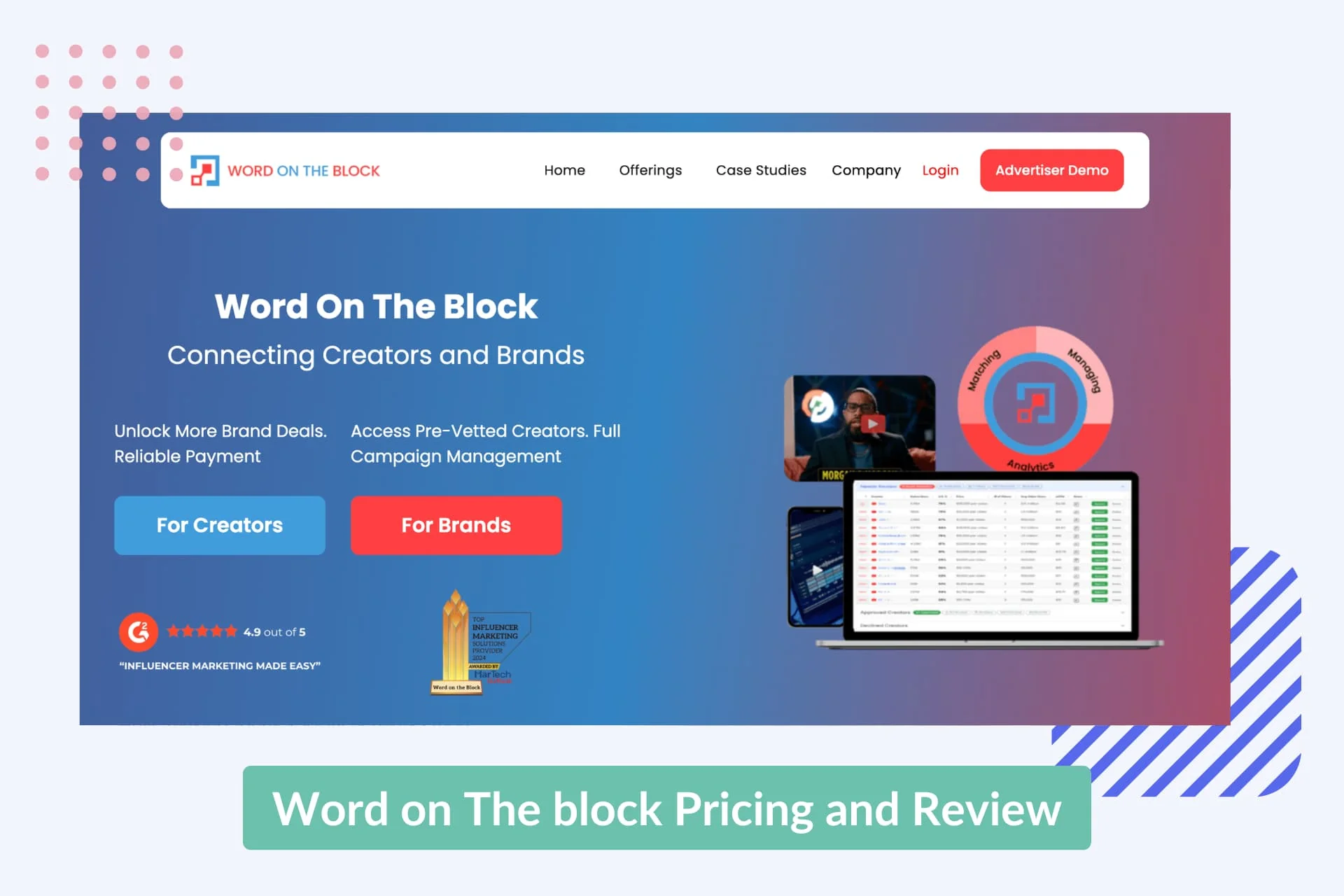
Word on the Block is a hybrid influencer marketing platform and managed service based in Manhattan. It started around 2019 as a New York ad network for local businesses, pivoted during the pandemic, and relaunched as a creator marketing company under CEO Seth Girsky alongside co-founders Charlie Erlikh and Tyler Kratky.
The positioning sits deliberately between two categories: SaaS platforms that give you a creator database and leave you to do the work, and agencies that do the work but charge a heavy retainer. Word on the Block reports 100,000+ pre-vetted creators, 60+ recurring campaigns, and over 1 billion total impressions, with brands including Bark, Bigelow Tea, Morgan & Morgan, BrandsMart USA, and Soundraw.
Word on the Block Key Features
Full-service campaign execution
The team handles creator discovery, outreach, negotiation, contracting, draft collection, posting schedules, and payment. You approve creators and approve drafts — that's the extent of your workload.
The trade-off is real: your draft comments go to Word on the Block, not to the creator. They relay everything. Less admin for you, but no direct line to the creator either.
Platform coverage including Twitch and YouTube long-form
Campaigns run on YouTube, Instagram, TikTok, Twitch, Facebook, and X. YouTube long-form integrations and sponsored Twitch streams are both supported, which most self-serve SaaS platforms handle badly or not at all.
If you're in gaming, finance, or any vertical where long-form YouTube converts better than 30-second Reels, this is the strongest reason to look at them.
Whitelisting and Spark Ads facilitation
They set up permissions for running paid ads from creator accounts, and describe the whitelisting platform itself as free. For brands treating creator content as paid media rather than organic reach, this matters more than the follower counts.
Real-time dashboard with conversion tracking
The brand dashboard reports views, engagement, clicks, and conversions per creator and per video, with export to Excel. Install their pixel and you get measurement down to ROI, which is more than most managed services hand over.
Creator-side terms that are genuinely fair
Creators pay nothing, keep 100% of the agreed rate with no percentage skimmed, and are guaranteed payment on net30 regardless of when the brand pays — Word on the Block absorbs that risk. This is unusual, and it tends to translate into better creator response rates and less churn mid-campaign.
Word on the Block Pricing
Here's the honest summary: Word on the Block does not publish a price.
Full-Service Campaigns — fixed cost per creator
The flagship offering. Covers end-to-end management, discovery and negotiation, execution and tracking, creator contracting, custom link and discount code distribution, and posting instructions like link-in-bio and collab posts. Usage rights for a set duration are listed as included here.
UGC Creation — fixed cost per creator
Content production without a posting requirement, with full usage rights. Priced per creator, same as above.
Affiliate Program — fixed cost per month
Affiliate recruitment and ongoing program management. This is the one offering billed monthly rather than per creator.
Payment Platform (beta) — 3% processing fee
You send one consolidated payment, they distribute to all creators across currencies and handle tracking. The only percentage figure published anywhere on the site.
Pricing Report (beta) — fixed monthly subscription
Aggregated rate data from their own creator negotiations, competitor benchmarking, and industry pricing trends. No number given.
What the fee actually is:
Their FAQ says they take "a modest fee" and deploy the rest of your budget on creators. That's the extent of the public disclosure. Company materials claim brands land roughly 30% below what they'd negotiate directly with creators, and that clients have hit sub-$5 CPMs — both are company-reported figures, not independently audited.
Hidden costs worth flagging:
- The take rate is the whole pricing question and it isn't answered publicly. You'll get a number in a proposal, not before.
- Usage rights are not automatic. The FAQ states plainly that brands don't automatically get paid usage rights to posted content, and that rights are facilitated separately. The pricing page lists usage rights under Full-Service Campaigns. Get this resolved in writing before signing.
- No self-serve entry point. Every path starts with a demo form or an email to their team. There's no way to price a small test yourself.
- Affiliate program is a separate monthly line item, not bundled into campaign work.
- Performance claims come from the vendor. Sub-$5 CPMs and 40%+ ROI lift appear in company PR, not third-party data.
Word on the Block Pros & Cons
Pros
- No subscription is a real cash-flow advantage. Aspire and GRIN both start around $2,000/month before you've paid a single creator. Word on the Block charges nothing until you run something.
- Twitch and YouTube long-form support. Genuinely underserved by the SaaS category, and a strong fit for gaming, finance, legal, and other long-consideration verticals.
- Creator terms are better than the industry norm. No cut off the creator's rate and guaranteed net30 payment regardless of the brand's schedule. Creators notice, and it shows in response rates.
- You get real conversion data, not a summary deck. Per-creator, per-video reporting with pixel-based ROI tracking and Excel export.
- Low operational lift. For a team with no influencer headcount, approving creators and drafts is a genuinely small ask.
Cons
- The fee isn't disclosed. For a company whose public pitch is transparency, the brand-side take rate being unpublished is the sharpest tension in the whole offering.
- You don't own the creator relationship. Comments route through their team, contracting sits with them, and there's no CRM you keep. Every renewal and rate negotiation runs back through the vendor.
- The site contradicts itself on usage rights. Pricing page says included, FAQ says not automatic. That's a material difference in cost.
- Thin independent validation. The G2 profile is unclaimed with a handful of reviews, and there's an open G2 discussion thread asking whether the company is legitimate. Young company, not a red flag on its own — but you're relying on references rather than review volume.
- No way to test small on your own. Everything goes through their team, which slows down brands that just want to try one campaign quickly.
What Word on the Block Users Say
Word on the Block holds a 4.8/5 on G2, but on a small number of reviews, and the profile is currently unclaimed by the company. That's the honest context for the rating — it's positive, but it isn't statistically meaningful yet.
The reviews that do exist land on the same themes: the team is responsive, the dashboard gives visibility without the work, and the service solves a specific pain. One mid-market marketing manager described getting real-time feedback and analytics while having full workflow visibility "without having to do any of the work."
Criticism is almost absent, and the closest thing to a complaint is telling: one reviewer said the only downside was "maybe the learning curve" because it's a different way of operating in influencer marketing. Another described their pre-Word-on-the-Block state as having software to find influencers but still needing to pitch themselves and hope for a response.
The signal worth weighing sits outside the reviews. A verified G2 user posted a discussion asking whether the company is legit, noting there wasn't much information available. For a 2023-era company with no outside funding, that's expected — but it means due diligence here means asking for client references, not reading aggregate scores.
Who Is Word on the Block Best For?
Word on the Block fits brands that have real budget for creator campaigns but no one internally to run them. If influencer marketing is a line item you want executed rather than a channel you want to build, the no-subscription model means you're not paying for software you won't log into.
It's a particularly good fit for verticals the SaaS platforms handle poorly: gaming and Twitch, legal services, sports betting, finance, and anything where a 12-minute YouTube integration outperforms a Reel. Their published client list leans that direction for a reason.
Where it stops making sense: brands building influencer marketing as owned infrastructure. If your goal is a roster of ambassadors you have direct relationships with, running campaigns through an intermediary who holds the contracts and relays your feedback works against you every quarter.
It's also a hard fit for finance teams that need line-item transparency. "A modest fee" on top of creator costs isn't something you can model before a proposal lands.
Is Word on the Block Worth It?
For the right brand, yes. Managed influencer services typically run $3,000 to $15,000/month in retainer before creator spend, and Word on the Block's pay-per-creator structure genuinely removes that floor. If you value time over control and you're in a vertical where YouTube long-form or Twitch matters, it's a reasonable way to get campaigns live without hiring.
It's not worth it if you're trying to build the channel properly. The undisclosed fee means you can't benchmark what you're paying, and the relayed-communication model means you're renting creator relationships rather than building them. Brands in that position should price a self-serve platform alongside any Word on the Block proposal and compare total cost over twelve months, not per campaign.
Word on the Block Alternatives
If Word on the Block isn't the right fit — whether the gap is pricing transparency, relationship ownership, or wanting to run things yourself — here are five alternatives worth a look.
Insense
A creator marketplace built around UGC and paid-social workflows, with strong Spark Ads and whitelisting support. Plans run roughly $500–650/month plus a 10–20% marketplace fee on creator payments. The reason to pick it over Word on the Block is simple: the fee is a published number you can model before you commit.
Influencer Hero
An all-in-one influencer marketing platform with creator discovery across Instagram, TikTok and YouTube, an influencer CRM, automated outreach and follow-ups, campaign management, affiliate and gifting tracking, payments, and reporting. Pricing is demo-based. You'd choose it over Word on the Block when you want to own the program rather than outsource it — the creator relationships, the outreach history, and the data all stay in your account instead of the vendor's.
Stack Influence
Fully managed micro-influencer campaigns priced at a flat fee per successful post, starting around $39 per promotion. Structurally the closest thing to Word on the Block's pay-per-creator model, but with the per-unit cost published upfront. Best for product-led D2C brands running volume over reach.
Aspire
A creator marketplace plus relationship management, with an optional managed services layer. Pricing starts around $2,000/month on an annual contract. Worth the jump if you're building long-term ambassador programs and want the community infrastructure that a per-campaign service doesn't give you.
GRIN
Creator management built for D2C brands, with deep CRM, ecommerce integrations, and gifting workflows, typically starting around $2,000/month. You'd pick it over Word on the Block when the point is to keep every creator relationship, conversation, and performance record in-house permanently.
Final Thoughts
Word on the Block does something specific and does it well: it takes influencer campaign execution off your team's plate without charging a platform fee for the privilege. The Twitch and YouTube long-form coverage is a real differentiator, and the creator-side terms — full rate, guaranteed net30, risk absorbed — are better than most of the industry. The limitation is that the fee isn't published, and the model means the creator relationships stay with the vendor rather than with you.
That last part is worth sitting with, because it's the question underneath every managed influencer service. You're paying someone to run campaigns, and when you stop paying, you're back where you started. Creator Hero works from the other direction: brands connect with creators who sell their products through commission-based storefronts, with commissions between 20% and 50% and no upfront campaign spend. The creators are motivated by sales, not by a booked deliverable.
Let the creators do the selling for you, so you can focus on developing new products and scaling your brand. Explore Creator Hero for brands or book a free demo to see how it works.


.svg)


%201.png)


_logo.svg.png)


