Phyllo pricing is fully custom — there are no public tiers, just a "Get a Quote" button and a sandbox you can sign up for. Third-party reports put the realistic entry point around $199/month, but the real number depends entirely on your API volume and use case.
In this review, we cover Phyllo's pricing model, standout features, real user feedback, and whether it's worth it for your team. The honest headline up front: Phyllo isn't a campaign platform you log into to run influencer programs — it's developer infrastructure.
If you're a brand or a SaaS team trying to decide whether Phyllo fits your stack (or whether you even need an API layer at all), this breakdown is for you.
Quick Summary
Best for: Tech teams building creator-facing products that need normalized data across many social platforms
Free trial: Sandbox sign-up, yes — no free production tier
G2 rating: ~4.4/5
Our verdict: Excellent data infrastructure for developers, but the wrong tool for a non-technical brand running campaigns.
What Is Phyllo?
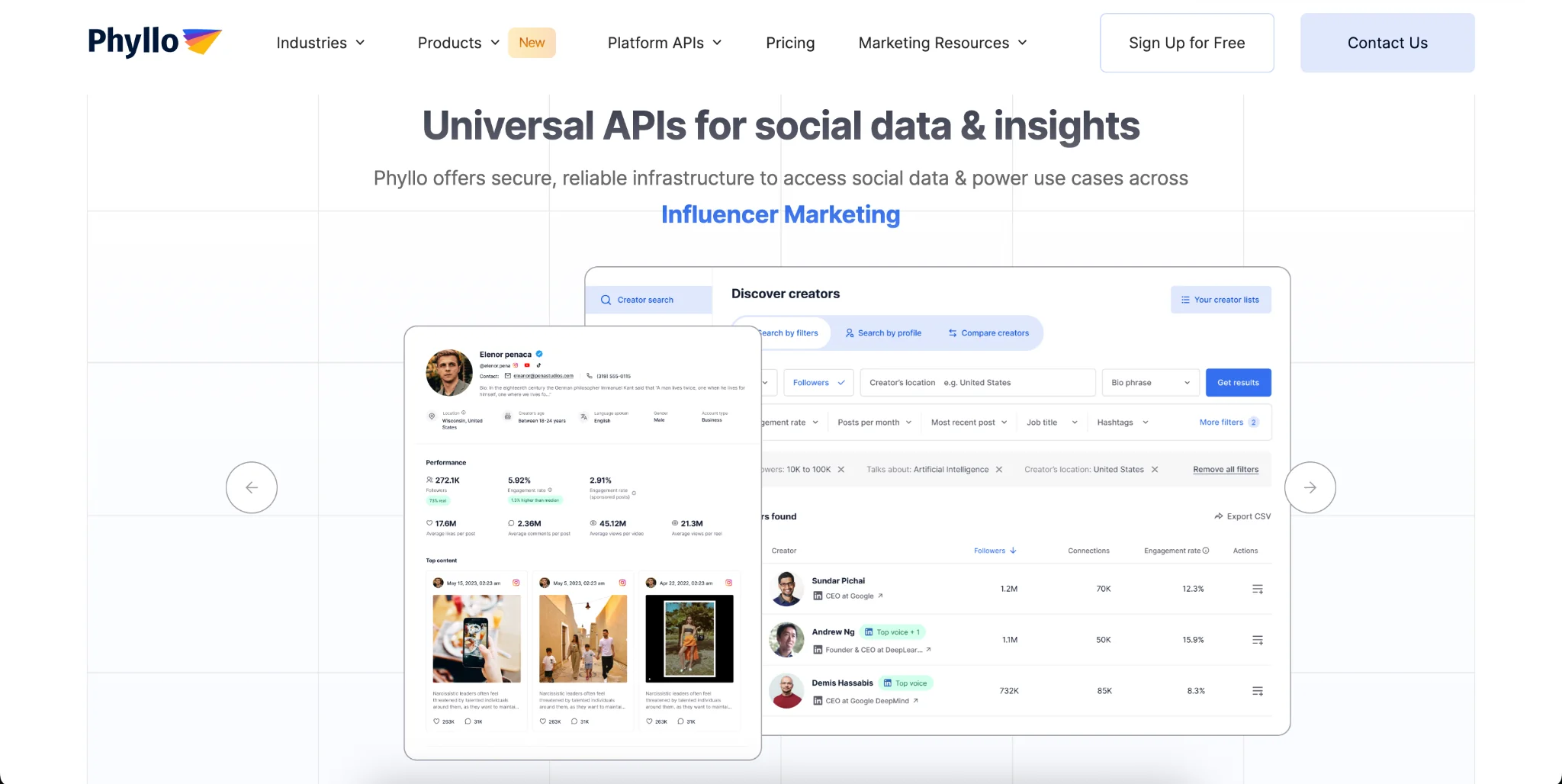
Phyllo is a unified API that connects your app to creator data across 20+ social platforms — Instagram, TikTok, YouTube, Facebook, X, and a long tail of others. Instead of integrating with each platform's API separately (and re-fixing your pipeline every time Meta changes something), you integrate once with Phyllo and pull normalized, consented data.
That's the core pitch: Phyllo is the plumbing, not the dashboard. It powers influencer discovery, vetting, social listening, social screening, and creator income verification — but as raw, developer-ready endpoints rather than a point-and-click interface.
It's worth knowing who actually uses it. Phyllo's customers are mostly companies building creator-economy products — influencer platforms, fintech apps verifying creator income, background-check tools — not D2C brands managing their own influencer campaigns. If you're evaluating Phyllo next to a roundup ofsearch tools, that distinction matters: most of those are finished products, and Phyllo is the layer underneath one.
Phyllo Key Features
Unified social data API. One integration gives you access to 20+ platforms with normalized outputs, so a follower count or engagement metric looks the same whether it came from TikTok or YouTube. This is the feature people actually pay for — it kills the maintenance burden of juggling separate platform APIs.
Consented, first-party creator data. Creators authenticate through Phyllo's SDK and grant access to their own data, which unlocks things public scrapers can't touch — like Instagram Stories, Reels, and YouTube Shorts metrics. The trade-off is that creators have to go through an OAuth flow, and some users report that step scares people off.
Webhooks and real-time updates. Phyllo pushes profile and content updates to your app automatically, so you're not constantly polling for fresh data. For teams building live dashboards or attribution models, this is a genuine time-saver.
Discovery and vetting endpoints. Beyond connected-account data, Phyllo offers influencer discovery, brand-fit scoring, fake-follower analysis, and social screening for brand safety. These are solid on paper, though they're aimed at developers wiring them into a product, not marketers clicking through results.
SOC 2 Type 1 compliance and broad coverage. Phyllo follows enterprise-grade security practices and advertises named account managers with a 3–6 business-hour SLA on higher commitments. For regulated use cases like fintech income verification, that compliance posture is a real selling point.
Phyllo Pricing
Phyllo operates on a fully custom pricing model. There are no tiered "Basic / Pro / Business" plans on its website — instead, you book a consultation, share your use case (number of creators, platforms, API call volume), and get a tailored quote.
Here's what each tier typically looks like based on user reports and public references:
Sandbox / Free Sign-Up
Limited access to the developer dashboard
Test API endpoints in a sandbox environment
No production-ready data pulls
This is the entry point for developers exploring the API. You can sign up directly, poke around the docs, and run basic test calls, but it's not built for live workloads. Use it to validate the integration before committing to a paid plan, and check Phyllo's signup page for current sandbox terms.
Starter / Standard Tier (Custom)
Reported entry around $199/month
Access to core social data APIs across major platforms
Webhook support and normalized data outputs
SOC 2 Type 1 compliance
This is where most early-stage SaaS teams and smaller agencies land. It typically covers Instagram, TikTok, YouTube, and a handful of other networks with capped API calls. If you're building a creator discovery tool or a creator-facing product, this is the realistic starting line.
Growth / Mid-Tier (Custom)
Higher API call volume
Access to additional endpoints (social listening, social screening, brand-fit modeling)
Dedicated technical support
Brands and platforms scaling past initial validation usually move here. Pricing scales primarily with volume — more creators connected, more API calls, more data points pulled per request. There's no published number, but expect a meaningful jump from the entry tier.
Enterprise (Custom)
Full platform access across 20+ social networks
Custom SLAs and dedicated account management
Advanced features like Video Intelligence and Measurement APIs
Built for large platforms, financial services companies, or agencies pulling creator data at scale. This is where Phyllo's enterprise customers sit. Pricing is fully bespoke and tied to volume, complexity, and the specific endpoints you need.
API Pricing
Phyllo's entire business is API pricing — that's the product. Costs scale with API call volume, number of connected creator accounts, and which endpoints you're using (basic profile data is cheaper than video intelligence or social listening). Hidden costs to watch for include data refresh frequency, webhook events, and per-platform pricing variation.
Worth noting: Influencer Hero also offersinfluencer marketing APIs, including Discovery, Raw, and Brand Collaborations endpoints — so if you're choosing between the two for an API-only use case, it's worth comparing both quotes directly.
Phyllo Pros & Cons
Here's the honest editorial read, based on user reviews and how the product is actually built.
Pros
It genuinely solves the multi-platform integration headache. One API instead of five, plus Phyllo absorbs the constant breaking changes from Meta and others. This is the single biggest reason teams stick with it.
Consented data unlocks metrics scrapers can't reach. Stories, Reels, and Shorts data are available because creators authenticate directly — valuable if your product needs accurate, first-party numbers.
Strong developer experience and documentation breadth. Webhooks, multiple SDKs (iOS, Android, React Native, Flutter, Web), and a wide use-case library make it fast to build on once you're in.
Enterprise-grade compliance. SOC 2 Type 1 and named account management make it viable for regulated use cases like income or identity verification.
Cons
Opaque pricing. No public numbers and no easy way to see your own usage. One reviewer flagged that custom API pricing is "confusing" and wished for a place to view usage stats — a recurring complaint.
Not plug-and-play. Phyllo is API-first, so without a dev team to build dashboards and pipelines, it's effectively unusable for a marketing team. There's no campaign manager, no outreach, no CRM.
Documentation can feel unstructured. Some users say the offerings and pricing aren't clearly laid out, which slows down evaluation and onboarding.
Creator authentication friction. A few teams report that the OAuth permissions — especially for YouTube — look daunting to creators and cause drop-off. If you want a faster read on a single account, a freefake follower tools check does the job without an integration.
What Phyllo Users Say
Phyllo holds a solid rating on G2 (in the mid-4s), and the praise is consistent: it saves engineering teams from building and maintaining a dozen separate platform integrations.
"By handling the frequent API changes from Meta, Phyllo ensures our data pipelines remain stable," one reviewer shared — a sentiment that comes up again and again from technical users who've offloaded their infrastructure to it.
The frustrations are just as consistent, and they cluster around pricing transparency and support. Multiple reviewers mention confusing custom pricing, documentation that isn't clearly structured, and slower-than-ideal support responses when bugs surface mid-build. The pattern across forums is clear: developers love what Phyllo does, but wish the commercial and onboarding side were as polished as the tech.
Who Is Phyllo Best For?
Phyllo is best for product and engineering teams building creator-economy software — influencer marketing platforms, link-in-bio tools, creator CRMs, fintech apps verifying creator income, or background-check products. If you need normalized data from many platforms and you have developers to wire it in, Phyllo is one of the strongest options on the market.
Where it falls short is the typical brand use case. If you're a D2C marketer who wants to find creators, run outreach, and track campaigns, Phyllo gives you raw materials, not a workflow — you'd be paying for an API and then building the actual tool on top of it.
For those teams, the better move is a finished platform or, if you'd rather not manage any of it in-house, working withmarketing agencies that handle sourcing and execution for you. Budget-wise, Phyllo makes sense when data is a core part of your product; it rarely makes sense as a line item for a brand just running campaigns.
Is Phyllo Worth It?
For its target audience, yes. If you're building software that depends on creator data, Phyllo is worth the spend — the alternative is hiring engineers to build and babysit integrations with every platform, which costs far more than a quote ever will. The compliance posture and consented-data access are hard to replicate cheaply.
For a brand running influencer marketing, no — and that's not a knock on Phyllo, it's a category mismatch. You'd be buying infrastructure when what you need is a platform. The opaque pricing and developer-only interface make it the wrong starting point for any team without engineering resources, and you'll get to value faster with a tool built for marketers.
Phyllo Alternatives
If Phyllo isn't the right fit — usually because you want a usable platform rather than raw API endpoints — here are five alternatives worth a look, ordered by how relevant they are to a brand evaluating Phyllo.
Modash
A discovery-first platform with 350M+ public creator profiles across Instagram, TikTok, and YouTube, plus fake-follower checks and Shopify-connected tracking. Transparent pricing starts at $199/month with a free trial. Pick it over Phyllo when you want creator data and discovery out of the box, with no integration to build.
Influencer Hero
An all-in-one influencer marketing platform: creator discovery across Instagram, TikTok, and YouTube, an influencer CRM, automated outreach, campaign management, affiliate and gifting tracking, payments, and reporting. Pricing is public and starts at $649/month.
It's a strong Phyllo alternative for two reasons — it runs the whole program end to end in one place, and it also offers Discovery, Raw, and Brand Collaborations APIs, so it can cover the API-only use case too. Best for D2C brands and agencies that want the full workflow instead of stitching point solutions together.
HypeAuditor
Built around audience analytics and fraud detection, with deep authenticity scoring and demographic data. Pricing is quote-based with reported entry plans in the few-hundred-per-month range. Choose it over Phyllo when vetting and audience quality are your main job and you want a ready interface, not endpoints.
Upfluence
A discovery and creator-management platform with strong e-commerce data and its own data-API offerings. Pricing is quote-based. It's a good middle ground if you want both a usable platform and some programmatic data access without going fully API-first like Phyllo.
Aspire
A creator marketplace and management platform with inbound creator applications, automated workflows, and deep gifting tools, typically around $2,300/month. Pick it over Phyllo when your priority is managing relationships and campaigns at scale rather than pulling raw data. For a broader comparison across these tools, thisalternatives roundup is a useful next stop.
Final Thoughts
Phyllo is excellent at what it's actually built for: giving developers a single, compliant, normalized API for creator data across 20+ platforms. The pricing is opaque and the product is developer-only, but for teams building creator-economy software, it earns its quote. For a brand running campaigns, it's simply the wrong category — you'd be buying plumbing when you need a house.
If you'd rather skip the software-and-campaign-management lift entirely, there's a different model worth considering: instead of finding, paying, and managing creators, you let creators sell your products through their own commission-based storefronts. That's the Creator Hero approach — 55,000+ brands in the directory, affiliate commissions of 20–50%, and no upfront campaign spend.
Let the creators do the selling for you, so you can focus on developing new products and scaling your brand. Explore Creator Hero for brands orbook a free demo to see how it works.
FAQs
How much does Phyllo cost?
Phyllo uses fully custom, quote-based pricing tied to your API call volume, connected accounts, and endpoints. Third-party reports put the entry point around $199/month, but there are no published tiers — you book a consultation for a tailored quote.
Does Phyllo have a free trial?
There's a free sandbox sign-up where developers can test endpoints, but no free production tier. You'll need a paid plan to pull live, production-ready data.
Is Phyllo good for non-technical brands?
Not really. Phyllo is API infrastructure that requires a development team to build on top of it. Brands that want to run campaigns without engineering resources are better served by a finished platform.
What is Phyllo best for?
Teams building creator-facing products — influencer platforms, creator tools, or fintech apps — that need normalized, consented data across many social networks from a single integration.
What's a good alternative to Phyllo?
For a usable platform with creator discovery built in, Modash is the closest swap. If you want the full end-to-end workflow plus optional API access, Influencer Hero is the stronger pick.
Related Posts
The incredible power of team collaboration is evident in the remarkable outcomes it can achieve
Influur pricing explained: no brand subscription, pay-as-you-go fees, real pros and cons, and our verdict on whether this creator marketplace is worth it in 2026.
Tagbox looks cheap at $19/month — but the feature most brands actually need is hidden behind an Enterprise quote. Here's the full pricing breakdown and our honest verdict.
Word on the Block charges no subscription — but its pricing page never tells you the fee. Here's what the model actually costs brands, what's included, and our honest verdict.
Build your own business without having to manage all the operational aspects of an e-commerce. Focus on creating content, driving sales and maximise your earnings!


.svg)


%201.png)



_logo.svg.png)


