Amplify Influencer pricing is refreshingly public: a Free plan, then paid tiers at $99 and $179/month, with a custom "Scale" plan for larger teams. No demo wall, no "contact sales" runaround to see a number — which already sets it apart from most tools in this space.
In this review, we cover Amplify Influencer's pricing tiers, standout features, real usage signals, and whether it's actually worth it for your team. The short version: it's an affordable, focused influencer CRM built around content approval and creator relationships — not a discovery database or an outreach machine.
If you're a D2C brand that already works with creators and you're tired of running the whole program out of a spreadsheet, this breakdown is for you.
Quick Summary
Best for: D2C and Shopify brands organizing 20+ ongoing creator relationships (not finding new ones)
Starting price: Free; paid plans from $99/month
Free trial: Yes — free plan and trial, no credit card required
G2 rating: No meaningful third-party rating yet (newer tool; reviews are first-party)
Our verdict: A genuinely affordable, well-scoped influencer CRM and content-approval tool — just don't expect it to find creators or run outreach for you.
What Is Amplify Influencer?
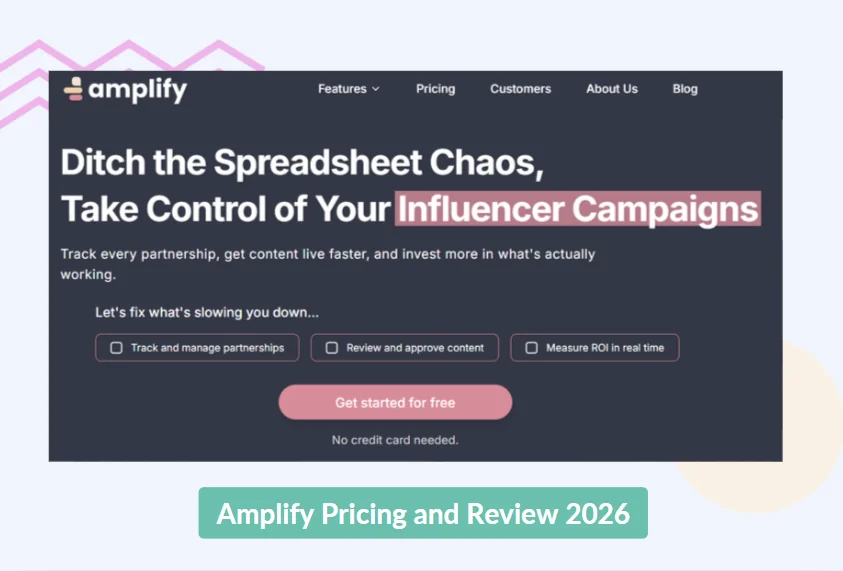
Amplify Influencer is an influencer marketing CRM built specifically for managing creator relationships, not sales deals. It pitches itself as the fix for the classic mess of five browser tabs, three tools, and one spreadsheet only one person on the team understands.
The core idea is relationship management: track every partnership from first outreach to final post, store contracts and deliverables, log content history, and see who needs a follow-up. It connects directly to Shopify to attribute sales and show ROI per influencer.
It's aimed at brands running ongoing programs — the kind of long-termambassador relationships where the same creators post repeatedly — rather than one-off sponsored drops. Amplify says many midsize brands use it to manage 50+ creators without enterprise complexity.
Amplify Influencer Key Features
Customizable CRM with Kanban pipelines. Visualize your creator funnel in Kanban or list views, drag partnerships between stages, and filter by owner, segment, campaign, or platform. It's the heart of the product and the reason most teams would buy it — a clean, filterable system to replace scattered spreadsheets.
Content review and approval pages. Every plan includes "Receive and Approve Content" and dedicated content review pages, so creators submit drafts and you approve or request changes in one place. This is a genuine differentiator — most affordable CRMs skip a real approval workflow.
Content Hub with usage rights. Paid tiers add a content hub that stores creator posts along withusage rights, so you can legally repurpose UGC across ads and landing pages. The free plan gets the hub without rights tracking, which is a meaningful gap if repurposing content is part of your plan.
Contracts, deliverables, and reminders. Upload signed contracts, view upcoming posts and deadlines, and set automatic reminders for missing content. For a program juggling dozens of creators, the "who owes us a post" visibility is where the tool earns its keep.
Shopify sales attribution. A native Shopify integration ties influencer activity back to revenue, so you can see which creators actually drive sales. Worth flagging: Shopify is the only e-commerce integration — there's no WooCommerce, Magento, or BigCommerce support here.
Amplify Influencer Pricing
No demo required — Amplify publishes its plans openly, and only the top tier is quote-based. Here's how it breaks down (monthly billing; an annual option is also available).
Free — $0/month.
Manage up to 5 influencers with the standard CRM, content review pages, and the content hub. It's a real free plan, not a trial timer, which makes it a legitimate way to test the workflow before paying. The catch: no usage rights on stored content and a hard 5-creator ceiling.
Essentials — $99/month.
The "most popular" tier bumps you to 25 influencers and unlocks the customizable CRM plus the content hub with usage rights. For a small brand running a real program, this is the practical entry point, and $99 undercuts almost every comparable tool — even value-focused options likeSARAL's pricing start far higher.
Growth — $179/month.
Same feature set as Essentials, but the cap rises to 60 influencers. The jump is purely about volume — if you're actively onboarding creators past 25, this is where you land.
Scale — Custom.
Unlimited influencers with everything in Growth, priced on request via a demo. This is the only tier where you'll actually talk to sales.
One thing to watch: the tiers are gated by influencer count, not seats or features, so the real question is how fast your active-creator list grows. There are no obvious setup fees or overage traps, which is a nice change of pace for the category.
Amplify Influencer Pros & Cons
Pros
Transparent, low pricing. A genuine free plan and a $99 entry point make it one of the most accessible influencer CRMs available — no demo gatekeeping.
Built-in content approval. Dedicated review pages and an approval flow are unusual at this price and genuinely useful for content-heavy programs.
Usage-rights tracking. Storing UGC with rights attached (on paid plans) saves real legal headaches when you repurpose content into ads.
Purpose-built for relationships. Kanban pipelines, contract storage, deliverable reminders, and per-influencer ROI are tailored to ongoing programs, not generic sales CRMs.
Cons
No creator discovery. There's no searchable influencer database — you bring your own list via CSV. If you need to find creators, this isn't the tool.
Outreach automation is thin. Amplify tracks outreach stages and sends reminders, but true automated email sequencing is still on the roadmap, so bulk outreach happens outside the platform for now.
Shopify-only e-commerce. No WooCommerce, Magento, or BigCommerce integrations, which rules it out for brands off Shopify.
Limited independent proof. There's little third-party review presence yet, so you're largely evaluating on the free plan and first-party testimonials.
What Amplify Influencer Users Say
Here's the honest caveat: Amplify Influencer doesn't have a meaningful footprint on G2, Capterra, or Trustpilot yet. It's a newer, niche tool, so the social proof you'll find is mostly first-party testimonials on its own site rather than verified, independent reviews.
Those testimonials lean on a consistent theme — cutting influencer admin time by automating follow-ups and replacing spreadsheets, and getting clearer visibility into which creators drive results. That tracks with the product's design, but it's marketing copy, not neutral feedback, so weight it accordingly.
The practical move: use the free plan to pressure-test the CRM and content approval flow with a handful of real creators, and ask Amplify for a couple of reference customers before committing to a paid tier. With a tool this early, hands-on testing beats star ratings.
Who Is Amplify Influencer Best For?
Amplify is a strong fit for small-to-mid D2C and Shopify brands that already have creators and need to get organized — moving a program off spreadsheets into a real pipeline with content approval, contracts, and sales attribution. Teams managing roughly 20 to 60 ongoing partnerships are the sweet spot.
It's also a sensible pick for content-led programs where approvals and usage rights matter, and where budgeting creator content — from gifting to paidUGC rates — is part of the workflow. The content hub and review pages do real work there.
Where it falls short: brands that need to discover creators, run automated outreach at scale, or operate off Shopify. If your program depends on sourcing new influencers every month or firing off hundreds of personalized emails, you'll outgrow Amplify fast — or never fully adopt it in the first place.
Is Amplify Influencer Worth It?
For the right brand, yes. At $99–$179/month with a free plan to start, Amplify is one of the cheapest ways to run a structured, content-approved influencer program — and the approval workflow and usage-rights tracking punch above the price. If you already have your creators and just need to stop losing track of them, it's easy to justify.
It's not worth it if you're expecting an all-in-one platform. The missing discovery database, roadmap-stage outreach automation, Shopify-only integration, and thin third-party validation mean it's a focused CRM, not a full stack. Brands that need sourcing, outreach, and multichannel attribution should keep looking.
Amplify Influencer Alternatives
If Amplify isn't the right fit — usually because you need discovery, real outreach automation, or non-Shopify support — here are five alternatives worth a look, and there are plenty ofother CRM tools in the category if you want to compare further.
Influencer Hero
Is the best influencer marketing platform covering creator discovery across Instagram, TikTok, and YouTube, an influencer CRM, automated outreach and follow-ups, campaign management, affiliate and gifting tracking, and payments. Pricing is custom and demo-based. It's the natural step up for a brand that wants to run the entire program end to end in one tool instead of pairing Amplify with separate discovery and outreach solutions.
SARAL (GetSaral)
The closest match: an affordable influencer CRM for small DTC brands with a Chrome-extension discovery tool Amplify lacks, plus outreach and relationship management. Pricing runs roughly $12K–$25K/year. Pick it over Amplify if you want discovery baked in and don't mind a higher floor.
GRIN
A heavier creator-management CRM built for established e-commerce brands treating influencer marketing as a core channel, typically starting around $25,000/year. Choose it over Amplify when you've scaled well past 60 creators and need enterprise-grade workflows and reporting.
Modash
A discovery and monitoring platform with a massive creator database, from about $299/month. It's the opposite trade-off from Amplify — strong on finding and vetting creators, lighter on relationship CRM — so brands often use it precisely because Amplify can't source.
Social Cat
An affordable, beginner-friendly option for small brands, running roughly $99–$299/month, with product-seeding workflows and a basic CRM. A fair alternative if you want a low-cost tool that also helps you connect with new micro-influencers.
Final Thoughts
Amplify Influencer does one thing well: it turns a chaotic, spreadsheet-run creator program into an organized CRM with content approval, usage rights, contracts, and Shopify-based ROI — all at a genuinely low price. Its limits are just as clear: no discovery, roadmap-stage outreach, Shopify-only integration, and little independent proof yet.
If you'd rather skip the campaign-management overhead entirely, there's a different model worth knowing. Creator Hero isn't another SaaS platform to learn — it's a storefront builder where creators sell your products through their own commission-based storefronts (20–50% commissions, no upfront campaign spend), backed by a directory of 55,000+ brands and plans that start free ($19/mo Pro, $65/mo Premium).
Let the creators do the selling for you, so you can focus on developing new products and scaling your brand. Explore Creator Hero for brands orbook a free demo to see how it works.
FAQs
How much does Amplify Influencer cost?
It has a Free plan for up to 5 influencers, then Essentials at $99/month (25 influencers) and Growth at $179/month (60 influencers). The unlimited "Scale" tier is custom-priced via a demo.
Does Amplify Influencer have a free trial?
Yes — there's a genuine free plan plus a trial, and no credit card is required to start. It's an easy way to test the CRM and content-approval workflow before paying.
Does Amplify Influencer find influencers for you?
No. It has no discovery database — you import your own creator list via CSV. It's built to manage and organize relationships, not to source new creators.
Is Amplify Influencer worth it for small brands?
For small D2C or Shopify brands that already have creators and want to get off spreadsheets, yes — the price and content-approval workflow are hard to beat. Brands needing discovery or heavy outreach should look elsewhere.
What's a good alternative to Amplify Influencer?
SARAL is the closest affordable match with discovery built in, while Influencer Hero is the strongest all-in-one option if you want discovery, outreach, and payments in one platform.
Related Posts
The incredible power of team collaboration is evident in the remarkable outcomes it can achieve
Influur pricing explained: no brand subscription, pay-as-you-go fees, real pros and cons, and our verdict on whether this creator marketplace is worth it in 2026.
Tagbox looks cheap at $19/month — but the feature most brands actually need is hidden behind an Enterprise quote. Here's the full pricing breakdown and our honest verdict.
Word on the Block charges no subscription — but its pricing page never tells you the fee. Here's what the model actually costs brands, what's included, and our honest verdict.
Build your own business without having to manage all the operational aspects of an e-commerce. Focus on creating content, driving sales and maximise your earnings!


.svg)


%201.png)


_logo.svg.png)


