La tarification d'Amplify Influencer est agréablement transparente : un plan gratuit, puis des formules payantes à $99 et $179/mois, avec un plan personnalisé « Scale » pour les équipes plus grandes. Pas de mur de démo, pas de « contactez le service commercial » pour voir un prix — ce qui la distingue déjà de la plupart des outils du secteur.
Dans cet avis, nous examinons les niveaux tarifaires d'Amplify Influencer, ses fonctionnalités phares, les signaux d'utilisation réels, et si c'est vraiment rentable pour votre équipe. En bref : c'est un CRM influenceur abordable et bien ciblé, construit autour de l'approbation de contenu et des relations créateurs — et non une base de données de découverte ou un outil d'outreach.
Si vous êtes une marque D2C qui collabore déjà avec des créateurs et qui en a assez de gérer tout le programme via un tableur, cette analyse est faite pour vous.
Résumé rapide
Meilleur pour : Les marques D2C et Shopify organisant 20+ relations créateurs en cours (pas la recherche de nouveaux)
Prix de départ : Gratuit ; formules payantes à partir de $99/mois
Période d'essai gratuite : Oui — plan gratuit et essai, aucune carte bancaire requise
Note G2 : Pas encore d'évaluation tiers significative (outil récent ; les avis sont en direct)
Notre verdict : Un CRM influenceur et outil d'approbation de contenu véritablement abordable et bien pensé — attendez-vous simplement à ce qu'il ne trouve pas de créateurs ou ne gère pas l'outreach pour vous.
Qu'est-ce qu'Amplify Influencer ?
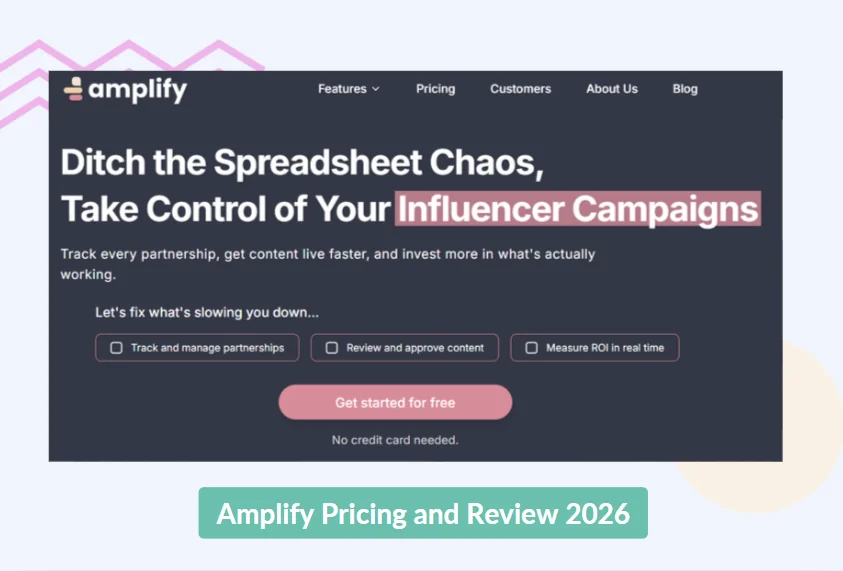
Amplify Influencer est un CRM de marketing d'influence conçu spécifiquement pour gérer les relations créateurs, non les contrats commerciaux. Elle se présente comme la solution au chaos classique : cinq onglets ouverts, trois outils différents, et une feuille de calcul que seule une personne comprend.
L'idée centrale est la gestion des relations : suivre chaque partenariat de la première prise de contact au dernier post, archiver les contrats et livrables, enregistrer l'historique de contenu, et voir qui a besoin d'un suivi. Elle se connecte directement à Shopify pour attribuer les ventes et afficher le ROI par influenceur.
Elle cible les marques avec des programmes établis — le type de partenariats à long termed'ambassadeur où les mêmes créateurs publient régulièrement — plutôt que des collaborations ponctuelles. Amplify affirme que de nombreuses marques de taille intermédiaire l'utilisent pour gérer 50+ créateurs sans complexité d'entreprise.
Fonctionnalités clés d'Amplify Influencer
CRM personnalisable avec pipelines Kanban. Visualisez votre entonnoir de créateurs en vue Kanban ou liste, faites glisser les partenariats entre les étapes, et filtrez par propriétaire, segment, campagne ou plateforme. C'est le cœur du produit et la raison pour laquelle la plupart des équipes l'achèteraient — un système propre et filtrable qui remplace les feuilles de calcul éparses.
Pages de révision et approbation de contenu. Tous les plans incluent « Recevoir et approuver du contenu » et des pages dédiées d'examen de contenu, afin que les créateurs soumettent les brouillons et vous approuviez ou demandiez des modifications en un seul endroit. C'est un véritable différenciateur — la plupart des CRM abordables passe à côté d'un vrai flux d'approbation.
Hub de contenu avec droits d'utilisation. Les formules payantes ajoutent un hub de contenu qui stocke les publications de créateurs ainsi que lesdroits d'utilisation, afin que vous puissiez réutiliser légalement le UGC dans les annonces et landing pages. Le plan gratuit inclut le hub sans suivi des droits, ce qui est une lacune significative si la réutilisation de contenu fait partie de votre stratégie.
Contrats, livrables et rappels. Téléchargez les contrats signés, consultez les prochains posts et échéances, et configurez des rappels automatiques pour le contenu manquant. Pour un programme gérant des dizaines de créateurs, la visibilité sur « qui nous doit un post » est où l'outil justifie son coût.
Attribution des ventes Shopify. Une intégration Shopify native relie l'activité des influenceurs aux revenus, pour que vous voyiez quels créateurs génèrent vraiment des ventes. À noter : Shopify est la seule intégration e-commerce — il n'y a pas de support WooCommerce, Magento ou BigCommerce.
Tarification d'Amplify Influencer
Pas de démo requise — Amplify publie ses formules ouvertement, et seul le niveau supérieur est sur devis. Voici comment cela se ventile (facturation mensuelle ; une option annuelle est également disponible).
Gratuit — $0/mois.
Gérez jusqu'à 5 influenceurs avec le CRM standard, les pages d'approbation de contenu, et le hub de contenu. C'est un vrai plan gratuit, pas un minuteur d'essai, ce qui en fait un vrai moyen de tester le flux avant de payer. Le bémol : pas de droits d'utilisation sur le contenu stocké et un plafond dur de 5 créateurs.
Essentials — $99/mois.
Le tier « most popular » vous fait passer à 25 influenceurs et déverrouille le CRM personnalisable plus le content hub avec droits d'utilisation. Pour une petite marque qui gère un vrai programme, c'est le point d'entrée pratique, et 99 $ undercut presque tous les outils comparables — même les options axées sur la valeur commeles tarifs de SARAL commencent beaucoup plus haut.
Growth — 179 $/mois.
Même ensemble de fonctionnalités qu'Essentials, mais la limite monte à 60 influenceurs. Le saut concerne uniquement le volume — si vous intégrez activement des créateurs au-delà de 25, c'est à ce niveau que vous arrivez.
Scale — Personnalisé.
Influenceurs illimités avec tout ce qui est dans Growth, au prix demandé via une démo. C'est le seul tier où vous parlerez réellement avec l'équipe commerciale.
Une chose à surveiller : les tiers sont limités par le nombre d'influenceurs, pas par les sièges ou les fonctionnalités, donc la vraie question est la vitesse à laquelle votre liste de créateurs actifs s'étend. Il n'y a pas de frais de configuration évidents ou de pièges de dépassement, ce qui est un changement bienvenu pour la catégorie.
Points forts et faibles d'Amplify Influencer
Points forts
Tarification transparente et basse. Un vrai plan gratuit et un point d'entrée à 99 $ en font l'un des CRM d'influenceurs les plus accessibles disponibles — aucun gatekeeping de démo.
Approbation de contenu intégrée. Les pages d'examen dédiées et un flux d'approbation sont inhabituels à ce prix et vraiment utiles pour les programmes riches en contenu.
Suivi des droits d'utilisation. Stocker l'UGC avec les droits attachés (sur les plans payants) évite de véritables maux de tête juridiques quand vous réutilisez du contenu dans des annonces.
Conçu spécifiquement pour les relations. Les pipelines Kanban, le stockage des contrats, les rappels de livrables et le ROI par influenceur sont adaptés aux programmes continus, pas aux CRM de vente génériques.
Points faibles
Pas de découverte de créateurs. Il n'y a pas de base de données d'influenceurs consultable — vous apportez votre propre liste via CSV. Si vous avez besoin de trouver des créateurs, ce n'est pas l'outil.
L'automatisation de la prospection est minimaliste. Amplify suit les étapes de prospection et envoie des rappels, mais la véritable séquence de courrier électronique automatisée est toujours sur la feuille de route, donc la prospection en masse se fait en dehors de la plateforme pour l'instant.
E-commerce Shopify uniquement. Aucune intégration WooCommerce, Magento ou BigCommerce, ce qui l'exclut pour les marques hors de Shopify.
Preuves indépendantes limitées. Il y a peu de présence d'examen tiers pour l'instant, donc vous évaluez largement sur le plan gratuit et les témoignages de première partie.
Ce que disent les utilisateurs d'Amplify Influencer
Voici la mise en garde honnête : Amplify Influencer n'a pas de présence significative sur G2, Capterra ou Trustpilot pour l'instant. C'est un outil nouveau et de niche, donc la preuve sociale que vous trouverez est surtout des témoignages de première partie sur son propre site plutôt que des avis vérifiés et indépendants.
Ces témoignages se concentrent sur un thème cohérent — réduire le temps administratif des influenceurs en automatisant les suivis et en remplaçant les feuilles de calcul, et obtenir une meilleure visibilité sur les créateurs qui génèrent des résultats. C'est en ligne avec la conception du produit, mais c'est du texte marketing, pas un retour neutre, donc pesez-le en conséquence.
Le mouvement pratique : utilisez le plan gratuit pour tester le CRM et le flux d'approbation de contenu avec quelques créateurs réels, et demandez à Amplify quelques clients de référence avant de vous engager sur un tier payant. Avec un outil à ce stade, les tests pratiques battent les évaluations en étoiles.
Pour qui Amplify Influencer est-il le mieux adapté ?
Amplify est un bon choix pour les petites et moyennes marques D2C et Shopify qui ont déjà des créateurs et qui ont besoin de s'organiser — faire passer un programme des feuilles de calcul à un vrai pipeline avec approbation de contenu, contrats et attribution des ventes. Les équipes gérant environ 20 à 60 partenariats continus sont le point d'entrée idéal.
C'est aussi un choix judicieux pour les programmes menés par le contenu où les approbations et les droits d'utilisation sont importants, et où budgétiser le contenu des créateurs — du gifting aux tarifs UGC payants — fait partie du flux de travail. Le content hub et les pages de révision font du vrai travail là.
Où cela fait défaut : les marques qui ont besoin de découvrir des créateurs, de mener une prospection automatisée à l'échelle ou de fonctionner en dehors de Shopify. Si votre programme dépend de l'approvisionnement de nouveaux influenceurs chaque mois ou de l'envoi de centaines d'e-mails personnalisés, vous dépasserez rapidement Amplify — ou ne l'adopterez jamais complètement.
Amplify Influencer en vaut-il la peine ?
Pour la bonne marque, oui. À 99–179 $/mois avec un plan gratuit pour commencer, Amplify est l'un des moyens les moins chers de gérer un programme d'influenceurs structuré et approuvé pour le contenu — et le flux d'approbation et le suivi des droits d'utilisation surpassent le prix. Si vous avez déjà vos créateurs et que vous avez juste besoin d'arrêter de les perdre de vue, c'est facile à justifier.
Ce n'est pas la peine si vous attendez une plateforme tout-en-un. La base de données de découverte manquante, l'automatisation de prospection en phase de feuille de route, l'intégration Shopify uniquement et la validation tierce mineure signifient que c'est un CRM ciblé, pas une pile complète. Les marques qui ont besoin d'approvisionnement, de prospection et d'attribution multicanal devraient continuer à chercher.
Alternatives à Amplify Influencer
Si Amplify n'est pas la bonne solution — généralement parce que vous avez besoin de discovery, d'une vraie automatisation de prospection, ou d'un support non-Shopify — voici cinq alternatives qui méritent un coup d'œil, et il y a plenty ofother CRM tools dans la catégorie si vous voulez pousser la comparaison plus loin.
Influencer Hero
C'est la meilleure plateforme de marketing d'influence couvrant la découverte de créateurs sur Instagram, TikTok et YouTube, un CRM pour influenceurs, la prospection automatisée et les relances, la gestion de campagnes, le suivi des partenariats et envois de produits, et les paiements. La tarification est sur mesure et basée sur une démo. C'est l'étape naturelle pour une marque qui veut exécuter l'intégralité de son programme en un seul outil plutôt que d'associer Amplify à des solutions distinctes de découverte et de prospection.
SARAL (GetSaral)
La solution la plus proche : un CRM d'influence abordable pour les petites marques DTC avec un outil de discovery via extension Chrome qu'Amplify n'a pas, plus la prospection et la gestion des relations. La tarification tourne autour de $12K–$25K/an. Choisissez-le plutôt qu'Amplify si vous voulez la découverte intégrée et que vous ne craignez pas un prix plancher plus élevé.
GRIN
Un CRM de gestion de créateurs plus complet, conçu pour les marques e-commerce établies qui traitent le marketing d'influence comme un canal clé, généralement à partir de $25,000/an. Préférez-le à Amplify si vous avez dépassé les 60 créateurs et que vous avez besoin de workflows et de rapports au niveau entreprise.
Modash
Une plateforme de discovery et de monitoring avec une énorme base de données de créateurs, à partir d'environ $299/mois. C'est l'inverse du compromis d'Amplify — forte pour trouver et évaluer des créateurs, plus légère sur le CRM relationnel — donc les marques l'utilisent souvent précisément parce qu'Amplify ne peut pas sourcer.
Social Cat
Une option abordable et conviviale pour les petites marques, coûtant environ $99–$299/mois, avec des workflows de seeding de produits et un CRM basique. Une bonne alternative si vous voulez un outil bon marché qui vous aide aussi à vous connecter avec de nouveaux micro-influenceurs.
Dernières Réflexions
Amplify Influencer excelle dans un domaine : transformer un programme de créateurs chaotique et basé sur des feuilles de calcul en un CRM organisé avec approbation de contenu, droits d'utilisation, contrats et ROI basé sur Shopify — tout à un prix vraiment bas. Ses limites sont tout aussi évidentes : pas de découverte, prospection au stade de la feuille de route, intégration Shopify uniquement, et peu de preuves indépendantes pour l'instant.
Si vous préférez vous affranchir entièrement de la gestion de campagnes, il existe un modèle différent qui vaut la peine d'être connu. Creator Hero n'est pas une autre plateforme SaaS à apprendre — c'est un constructeur de vitrines où les créateurs vendent vos produits via leurs propres vitrines basées sur commission (commissions de 20–50 %, sans dépense de campagne initiale), soutenu par un répertoire de 55,000+ marques et des forfaits qui commencent gratuitement ($19/mo Pro, $65/mo Premium).
Laissez les créateurs faire la vente pour vous, afin que vous puissiez vous concentrer sur le développement de nouveaux produits et la croissance de votre marque. Explorez Creator Hero pour les marques ouréservez une démo gratuite pour voir comment cela fonctionne.
FAQs
Quel est le coût d'Amplify Influencer ?
Il propose un plan gratuit pour jusqu'à 5 influenceurs, puis Essentials à $99/mois (25 influenceurs) et Growth à $179/mois (60 influenceurs). Le niveau « Scale » illimité est tarifé sur mesure via une démo.
Amplify Influencer propose-t-il un essai gratuit ?
Oui — il y a un vrai plan gratuit plus un essai, et aucune carte de crédit n'est requise pour commencer. C'est un moyen simple de tester le CRM et le flux d'approbation du contenu avant de payer.
Amplify Influencer trouve-t-il des influenceurs pour vous ?
Non. Il n'a pas de base de données de découverte — vous importez votre propre liste de créateurs via CSV. Il est conçu pour gérer et organiser les relations, pas pour trouver de nouveaux créateurs.
Amplify Influencer vaut-il le coup pour les petites marques ?
Pour les petites marques D2C ou Shopify qui ont déjà des créateurs et veulent sortir des feuilles de calcul, oui — le prix et le flux d'approbation du contenu sont imbattables. Les marques ayant besoin de découverte ou de prospection importante devraient regarder ailleurs.
Quelle est une bonne alternative à Amplify Influencer ?
SARAL est l'option abordable la plus proche avec la découverte intégrée, tandis que Influencer Hero est l'option tout-en-un la plus puissante si vous souhaitez découverte, prospection et paiements sur une seule plateforme.
Related Posts
The incredible power of team collaboration is evident in the remarkable outcomes it can achieve
Tarification d'Influur expliquée : pas d'abonnement pour les marques, frais à l'usage, vrais avantages et inconvénients, et notre avis sur le fait que cette place de marché créateurs vaut le coup en 2026.
Tagbox semble bon marché à $19/mois — mais la fonctionnalité dont la plupart des marques ont vraiment besoin est cachée derrière un devis Enterprise. Voici le détail complet des tarifs et notre verdict honnête.
Word on the Block ne facture pas d'abonnement — mais sa page tarifaire ne vous dit jamais quel est le coût réel. Voici ce que le modèle coûte réellement aux marques, ce qui est inclus, et notre verdict honnête.
Build your own business without having to manage all the operational aspects of an e-commerce. Focus on creating content, driving sales and maximise your earnings!


.svg)


%201.png)


_logo.svg.png)


