If you're researching Upfluence pricing, here's the honest answer up front: Upfluence doesn't publish prices on its website, but based on actual demo quotes, a typical entry setup runs $1,276/month — about $16,007/year billed monthly, or $14,406 paid upfront. That covers all three core modules (Search & Contact, Workflow, Payments), one seat, and onboarding.
In this review, we cover Upfluence's pricing tiers, standout features, real user feedback, and whether it's worth it for your team in 2026. If you're a D2C brand or agency running influencer programs at scale and evaluating your software options, this breakdown is for you.
Quick Summary
Best for: D2C ecommerce brands on Shopify, WooCommerce, or Amazon scaling influencer-led acquisition
Starting price: ~$1,276/month (full annual license with all three modules)
Our verdict: Powerful ecommerce-native influencer platform — but the $14K+ yearly minimum and annual lock-in put it out of reach for smaller brands.
What Is Upfluence?
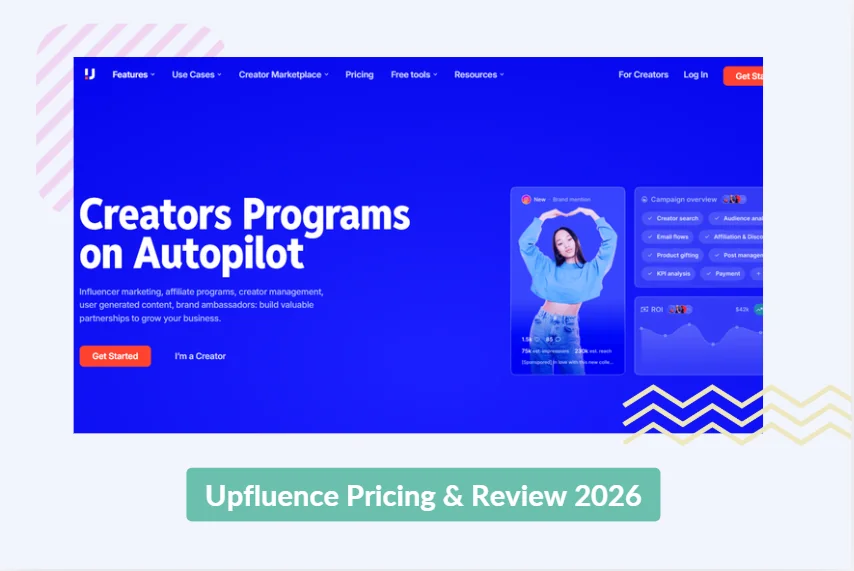
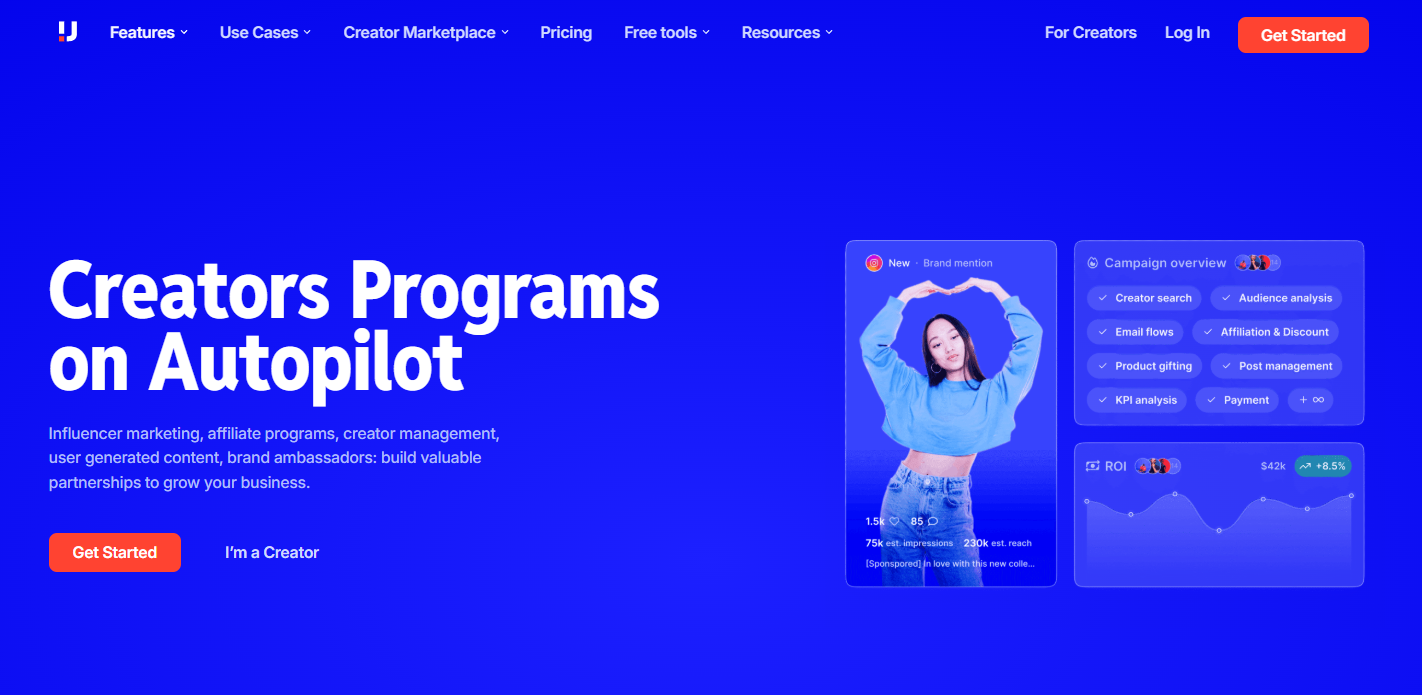
Upfluence is a cloud-based influencer marketing platform built around a search engine of 9M+ influencer profiles and a strong set of ecommerce integrations. It's best known for helping D2C brands identify influencers hiding inside their own customer base — meaning people already buying from you on Shopify, opening your Klaviyo emails, or visiting your site.
The platform is positioned for mid-market and enterprise brands that want a single tool for discovery, outreach, campaign management, affiliate tracking, and payments. In 2025–2026 they layered in Jaice, their AI campaign co-pilot, which automates outreach and creator matching.
Upfluence Key Features
Live Capture (in-store influencer detection). This is Upfluence's most distinctive feature. A snippet on your website analyzes the social reach of visitors and customers, then pipes anyone with influence into your Upfluence dashboard. For ecommerce brands, this is genuinely useful — you're recruiting from people who already buy from you.
Search engine with 9M+ profiles. You can filter by platform, location, audience demographics, engagement rate, and weighted keywords. The keyword weighting is powerful: you can tell the search to prioritize "skincare" over "lifestyle" and get tighter results than competitors that treat all keywords equally.
Influencer Relationship Management (IRM). Centralized CRM tool for managing creators across campaigns. Includes response scores (average response time per influencer), tagging, list management, and CSV export. Useful, but several G2 reviewers note that outreach follow-up still requires significant manual effort.
Ecommerce + affiliate stack. Native integrations with Shopify, WooCommerce, Magento, BigCommerce, and Amazon (via Amazon Attribution). You can mass-generate discount codes compatible with all five ecommerce platforms, track affiliate sales, handle payments through Upfluence Pay, and pull ROI data into one place. This is where Upfluence genuinely outperforms more generic platforms.
Jaice AI co-pilot. Upfluence's AI assistant analyzes creator data, automates outreach, recommends matching creators, and handles administrative work. The AI tooling is helpful for scaling outreach but isn't a replacement for relationship work — reviewers note that response rates depend heavily on how customized your messaging actually is.
Upfluence Pricing
Upfluence uses a modular, quote-based pricing model — and they don't publish their plans anywhere on the site. Pricing is locked behind a demo call. Based on actual demo quotes, here's what an annual license looks like in 2026:
Search and Contact Module — $399/month
Covers influencer search, matching, results, contact, and email integration. This is the discovery engine — and the module you can't skip if you want to use Upfluence at all.
Workflow Module — $399/month
Campaign tools, tracking, affiliation, and creator pages. This is what turns Upfluence from a search tool into a campaign management system. Most brands will need this from day one.
Payments Module — $399/month
Upfluence Pay (powered by Stripe) for creator payments. Optional in theory — but if you're running affiliate campaigns at scale, paying creators manually outside the platform becomes a real bottleneck.
Seats — $79/month per user
Pricing scales linearly per seat. Most plans start with one seat included.
Community Onboarding — $695 one-time
Required individual onboarding fee. Community access (5,000 creators) is included at no extra cost.
What it actually costs:
Total monthly cost: $1,276/month (all three modules + one seat)
Total yearly cost (billed monthly): $16,007/year
Total yearly cost (paid upfront): $14,406/year — roughly a 10% discount for paying annually
So the real entry point for a usable Upfluence setup is ~$14,000–$16,000/year, not the "starting at $478" figure quoted on third-party listings (which only covers one module). Plans for larger teams with more seats and modules scale into the $5,000+/month range.
Hidden costs to flag:
12-month annual contract is standard. This is the most common complaint on Trustpilot — brands believing they signed up for a trial month and discovering they're locked in for a year.
Modular pricing means feature gating. If you only buy Search & Contact, you can't run campaigns or process payments. Most brands need all three modules to actually use the platform.
Per-seat fees. $79/month per additional user adds up quickly for agencies or teams of 3+.
Upfluence Pros & Cons
Pros
Live Capture is genuinely differentiated. Most influencer marketing platforms only let you search external databases — Upfluence's ability to surface influencers from your existing customers is rare and valuable for D2C brands.
Broadest ecommerce integration list on the market. Shopify, WooCommerce, Magento, BigCommerce, and Amazon Attribution — most competitors only support one or two of these. If you're not on Shopify, Upfluence is one of the few platforms that still works.
Powerful search filters. Weighted keyword search and granular audience filters consistently get praised by G2 reviewers for surfacing more relevant creators than competitors.
Onboarding and customer support. This is one of the most consistent G2 themes — users repeatedly mention named CSMs and a smooth onboarding process as the platform's biggest strength.
All-in-one stack. Discovery, IRM, outreach, payments, affiliate tracking, AI assistance, and reporting under one roof, which matters for teams trying to reduce SaaS sprawl.
Cons
Annual contract lock-in. This shows up repeatedly on Trustpilot and Reddit. Multiple small business owners report being told they could try the platform and cancel, then discovering they were locked into 12 months. Read the contract carefully before signing.
Opaque pricing. No public pricing page, no plan comparison, no way to budget without sitting through a sales call.
Modular structure raises the floor. The "$399/module" sounds reasonable in isolation, but realistically you need all three modules to actually run campaigns — pushing the real minimum to ~$1,276/month before seats.
Quality of matched influencers varies. A recurring G2 complaint: low response rates and weak conversion from Upfluence-sourced creators despite significant spend.
Manual outreach work remains. Despite the AI tools and Jaice, several reviewers note that personalization and follow-ups still eat hours each week — the platform speeds things up but doesn't automate the relationship work.
What Upfluence Users Say
Upfluence holds a strong 4.6/5 on G2 across 139 reviews, with the most consistent praise going to customer support, onboarding, and the depth of search filters. The platform is rated well for User-Generated Content management (9.4) and Campaign Analytics (9.1) compared to direct competitors.
The picture flips on Trustpilot, where Upfluence sits at 3.4/5 — and almost every low review points to the same issue: contract terms. "We were approached by a sales representative who assured us we could try the software for one month and cancel easily if it didn't meet our needs," one user shared. "However, when we attempted to cancel, we were informed we were locked into a 12-month contract and required to pay the full annual fee."
On the upside, an ecommerce executive on G2 noted: "Live Capture is incredible — as a Shopify and Klaviyo user, I built an influencer network in just a few days." The split is telling: brands that get value out of Upfluence tend to be ecommerce-native teams that fully use the integrations, while frustrated reviewers tend to be smaller businesses that didn't realize the real cost-of-entry until they were already committed.
Who Is Upfluence Best For?
Upfluence is genuinely strong for D2C and ecommerce brands with $50K+ annual influencer marketing budgets, a dedicated person managing the program, and an existing customer base they want to mine for organic creators.
It starts to fall short for small brands or solo founders. The ~$14,000/year floor and annual contract mean the real cost-of-entry is significant — small teams without dedicated influencer ops often can't extract enough value to justify it. It's also limited for brands that want to skip the campaign management overhead entirely and just have creators sell their products on commission.
If your budget is under $1,000/month or you don't have someone to actively run campaigns, Upfluence will feel expensive and underused.
Is Upfluence Worth It?
For the right brand, yes. If you're an ecommerce-native company with a budget for ongoing influencer campaigns and someone managing the program in-house, Upfluence's integrations, Live Capture, Jaice AI, and discovery filters deliver real value — and the customer support is a genuine strength. It is a great tool for brands with presence in Amazon seller central, or similar ones from the company..
For everyone else, the math gets harder. The 12-month commitment, $14K+ real annual cost, and modular pricing structure mean you need a clear plan and active usage to justify it. Smaller brands, agencies testing influencer marketing for the first time, or teams that just want creators to drive sales without running campaigns will get more out of a different model entirely.
Final Thoughts
Upfluence is a serious tool with a clear strength: helping mid-market and enterprise D2C brands run influencer campaigns end-to-end inside their existing ecommerce stack — across Shopify, WooCommerce, BigCommerce, Magento, or Amazon. The Live Capture feature, broad integrations, and Jaice AI assistant are genuinely useful, and the support team gets consistent praise. The real cost is the contract and the $14K+ minimum spend, both of which need to factor heavily into your decision.
If you'd rather skip the campaign management overhead, the annual commitment, and the per-module pricing entirely, there's a fundamentally different approach worth considering. Creator Hero is a storefront builder — not a SaaS platform — where 55,000+ brands connect with creators who sell their products through commission-based storefronts. No upfront campaign spend, no contracts, no software learning curve. Creators earn 20–50% commission and handle the selling themselves.
Based on actual demo quotes, a full Upfluence setup with all three modules (Search & Contact, Workflow, Payments) plus one seat runs $1,276/month — about $16,007/year billed monthly, or $14,406/year paid upfront. Larger setups with more seats and add-ons scale into the $5,000+/month range.
Does Upfluence have a free trial?
Upfluence offers a limited free trial, but access requires going through a demo call first. Reviewers warn to confirm trial terms in writing before signing — many report being locked into a 12-month contract they didn't realize they agreed to.
What ecommerce platforms does Upfluence integrate with?
Upfluence integrates natively with Shopify, WooCommerce, Magento (Adobe Commerce), BigCommerce, and Amazon Attribution. It also connects with Klaviyo, Hootsuite, Gmail, Outlook, Zapier, and Stripe (via Upfluence Pay). This is one of the broadest ecommerce integration sets of any influencer marketing platform.
Is Upfluence worth it for small brands?
Generally no. The annual contract requirement and ~$14,000/year real-world starting cost make it a poor fit for small brands without dedicated influencer marketing resources. Smaller teams are usually better served by lower-commitment platforms or commission-based models like Creator Hero.
What's a good alternative to Upfluence?
It depends on what you need. For another full-stack SaaS, GRIN, Modash, and Aspire are common comparisons. If you want to skip campaign management entirely and have creators sell on commission, Creator Hero offers a fundamentally different model — storefront-based creator partnerships without contracts or campaign overhead.
Related Posts
The incredible power of team collaboration is evident in the remarkable outcomes it can achieve
Influur pricing explained: no brand subscription, pay-as-you-go fees, real pros and cons, and our verdict on whether this creator marketplace is worth it in 2026.
Tagbox looks cheap at $19/month — but the feature most brands actually need is hidden behind an Enterprise quote. Here's the full pricing breakdown and our honest verdict.
Word on the Block charges no subscription — but its pricing page never tells you the fee. Here's what the model actually costs brands, what's included, and our honest verdict.
Build your own business without having to manage all the operational aspects of an e-commerce. Focus on creating content, driving sales and maximise your earnings!


.svg)


%201.png)



_logo.svg.png)


