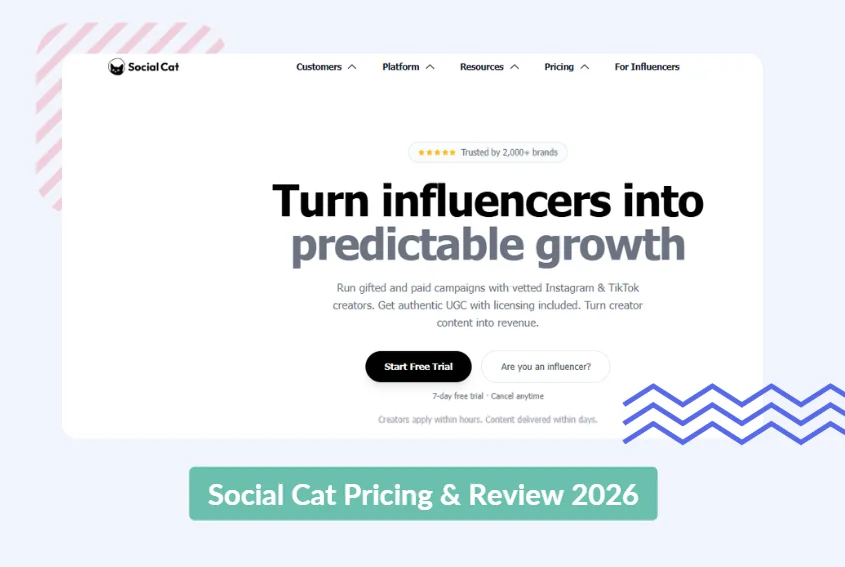
Social Cat Pricing & Review 2026: Features, Costs & Verdict
Social Cat pricing starts at $99/month and tops out at $299/month, with a 7-day free trial and no annual contract. It's one of the cheapest ways for a small brand to get into influencer marketing — but "cheap" comes with real trade-offs once you start scaling.
In this review, we cover Social Cat's pricing tiers, standout features, real user feedback, and whether it's actually worth it for your team. We'll also be honest about where it falls short, especially around integrations and content delivery.
If you're a D2C brand or startup running gifted and UGC campaigns on Instagram and TikTok — and you're trying to figure out whether Social Cat is the right entry point — this breakdown is for you.
Quick Summary
Best for: Small brands and startups running gifted micro-influencer campaigns on Instagram and TikTok
Starting price: $99/month (Essentials)
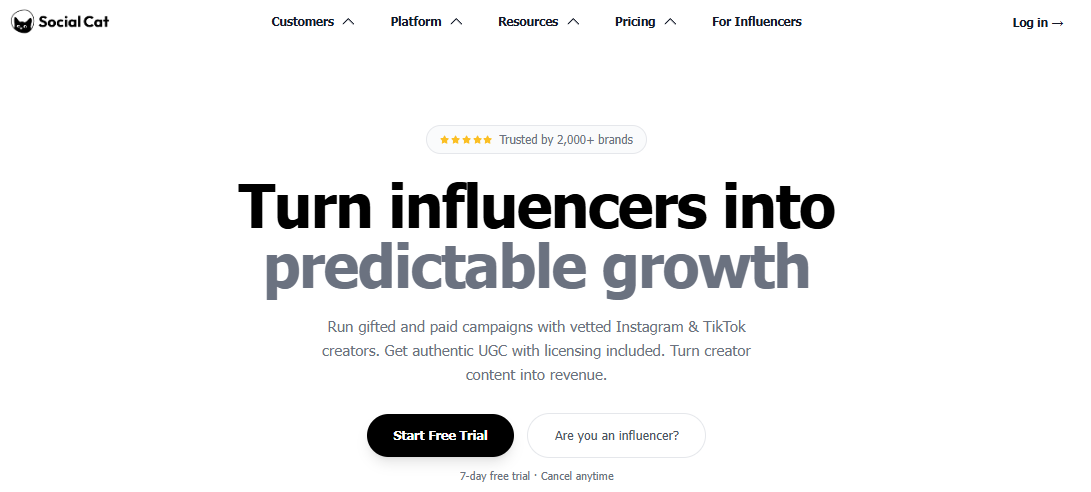
Free trial: Yes — 7 days
Trustpilot rating: ~4/5 (mixed; strong for creators, more polarized for brands)
Our verdict: A genuinely affordable on-ramp to micro-influencer gifting, but light on integrations, tracking, and accountability when creators don't deliver.
What Is Social Cat?
Social Cat is an influencer marketing platform built specifically to connect small and mid-sized brands with vetted micro-influencers for gifted, paid, and affiliate collaborations. It operates on Instagram and TikTok only, and is available primarily in the US, UK, Australia, and Canada. The platform leans into simplicity: brands create a campaign, creators apply (or get invited from a database of 500K+ creators), products get sent, and content comes back — usually within days.
The positioning is clear: Social Cat wants to be the most affordable, lowest-friction entry point into influencer marketing, aimed at brands that don't need (or can't justify) enterprise software. That focus is its biggest strength and, as you'll see, the root of most of its limitations.
Social Cat Key Features
Micro-influencer marketplace (500K+ creators). You can either post a campaign and let vetted creators apply, or proactively search and invite creators filtered by niche, location, and engagement. The manual vetting genuinely helps with quality, though the pool skews toward smaller creators in the 1K–50K follower range.
Gifted, paid, and affiliate campaigns. Social Cat supports product-for-content gifting (its core use case), paid collaborations where creators charge roughly $25–$500, and affiliate-style partnerships. For brands testing UGC on a tight budget, gifted campaigns are the obvious draw.
Content usage rights included on all plans. Every plan includes full licensing on the content creators produce, so you can legally reuse it in ads, on product pages, or across social. This is a meaningful perk — on bigger platforms, usage rights are often a paid add-on. If you're trying to fuel paid social with fresh creative, this matters.
In-app messaging and contracts. Communication, briefing, and contract drafting all happen inside the platform, which keeps collaborations organized without bolting on separate tools. It's basic, but it works for the volume most small brands run.
Meta and TikTok metrics integration. Social Cat pulls reach, impressions, engagement, and audience insights directly from Meta and TikTok. These are the only integrations. There's no Shopify, WooCommerce, or Amazon connection For eCommerce brands, that's a real gap, and one of the bigger reasons teams eventually look atShopify-native influencer software instead.
Social Cat Pricing
No annual lock-in here — every plan is month-to-month, and you can cancel anytime. There's a 7-day free trial across the board. Here's how the three tiers break down.
Essentials — $99/month
The entry tier, built for brands just starting out. You get up to 5 creator collaborations per month, 50 invites, 1 active campaign, 1 team member, unlimited content per collaboration, content usage rights, and email support. The math works out to roughly $20 per creator deal — but remember that's before product and shipping costs. The single-campaign, single-seat limit makes this strictly a "test the waters" plan.
Performance — $199/month
The middle tier and the one most brands actually land on. It bumps you up to 15 creators/month, 250 invites, 3 simultaneous campaigns, and 5 team members. You also unlock CRM tools, creator reviews, contract templates, influencer replacement, and exposure boosts twice a month. If you're running UGC at any real cadence, this is the realistic starting point — which means the "real" price of Social Cat is closer to $199 than $99.
Pro — $299/month
The top tier, aimed at brands with heavier needs: up to 30 creators/month, 500 invites, unlimited campaigns, 10 team members, priority support, and a dedicated account manager, plus extras like "Replace Matches" and a "Top Brand Badge." Even at the top end, you're capped at 30 creators a month — fine for a small program, limiting for anyone trying to scale aggressively.
Watch for these:
Social Cat doesn't offer a free plan or any free tools like engagement calculators or fake-follower checkers that competitors give away — so there's no zero-cost way to evaluate creator quality before subscribing. The bigger hidden cost is the one Social Cat can't put on a pricing page: when a gifted creator takes your product and ghosts, you eat the product and shipping cost with no real recourse. More on that below.
Social Cat Pros & Cons
Pros
Genuinely affordable entry point. At $99/month with no contract, it's one of the lowest-risk ways for a small brand to start running gifted campaigns. The cancel-anytime model removes most of the commitment risk.
Content usage rights on every plan. Full licensing included by default is a real cost saving versus platforms that charge for it separately — especially valuable if you're repurposing UGC into paid ads.
Manual creator vetting. Every influencer is reviewed before approval, which reduces (though doesn't eliminate) the fake-follower problem that plagues open marketplaces.
Fast and simple. Brands consistently say they can launch a first campaign in minutes and find relevant creators quickly, with no technical setup or learning curve.
Cons
No content-delivery guarantee. The most common complaint by far: creators receive free product and never post. Social Cat offers limited recourse when this happens, and brands absorb the loss.
No eCommerce integrations. No Shopify, WooCommerce, or Amazon connection means no automated gifting, shipment tracking, or sales attribution. You're tracking ROI manually, outside the platform.
Limited analytics and ROI tracking. You get reach, impressions, and engagement, but no built-in clicks-to-conversions or revenue-per-influencer reporting. Proving ROI is on you.
Low scaling ceiling. Even the $299 Pro plan caps you at 30 creators/month. Brands running serious programs outgrow this quickly.
Billing and cancellation friction. Recurring reports of difficulty cancelling trials and disputes over unexpected charges show up across review sites.
What Social Cat Users Say
Sentiment is genuinely split depending on who's reviewing. On Trustpilot, Social Cat carries a solid overall score driven largely by creators, who praise how easy it is to find relevant gifted and paid campaigns. Brands are more mixed. The platform earns consistent praise for being easy to use and for responsive customer support, but a recurring theme runs through the critical reviews: creators taking product and not delivering content.
One brand owner summed up the frustration on Trustpilot, noting that out of 11 influencers they worked with over two months, 4 of them received the product but never did a video or gave any explanation. Another reviewer was blunter, describing it as one of the most frustrating influencer platforms they'd ever tried after sending free product and paying shipping, only to get weeks of silence. Trustpilot's own summary of the reviews captures the pattern: several users reported issues with influencers not delivering content after receiving products, and a lack of accountability from the platform in such disputes.
The takeaway: the tooling itself is fine and the support team is responsive, but the gifted-campaign model carries inherent risk, and Social Cat doesn't fully insulate brands from it. That's not unique to Social Cat — it's the nature of gifting — but it's the single biggest thing to weigh before subscribing.
Who Is Social Cat Best For?
Social Cat is a strong fit for small brands, startups, and solo founders who want a cheap, simple way to start generating UGC and micro-influencer content on Instagram and TikTok. If your goal is to send out products, collect authentic content with usage rights included, and avoid expensive software or agency fees, it does that job well.
Where it starts to fall short is the moment you need to measure and scale. If you're running an eCommerce store and want to automate gifting, track which products drove which sales, or attribute revenue per creator, Social Cat doesn't have the integrations or analytics to support that — and you'll find yourself stitching together spreadsheets. Brands on Shopify, WooCommerce, or Amazon that are serious about affiliate tracking and ROI will outgrow it fast, and would be better served looking at affiliate and storefront-focused platforms.
Budget-wise, the platform's sweet spot is roughly $99–$199/month for a brand running light, gifting-first programs. Once you're pushing past 15–30 creators a month or need real performance data, the value equation tips toward more capable platforms. For brands ready to scale beyond these manual limits without breaking the bank, Influencer Hero stands out as an excellent alternative, offering the advanced automation, Shopify integration, and ROI tracking that Social Cat lacks.
Is Social Cat Worth It?
For its target user, yes. If you're a small brand dipping a toe into influencer marketing and you want vetted micro-creators, included content rights, and a sub-$200 monthly cost with no contract, Social Cat delivers exactly that. It's purpose-built for gifting and UGC at small scale, and on those terms it's hard to beat on price.
But it's not worth it if you need to prove ROI, automate eCommerce workflows, or scale beyond a few dozen creators. The lack of Shopify, WooCommerce, and Amazon integrations, the thin analytics, and the very real risk of creators not delivering all become bigger problems the more you invest. If any of those describe you, keep looking — the entry price is attractive, but the ceiling is low.
Final Thoughts
Social Cat does one thing well: it gets small brands into gifted micro-influencer campaigns quickly and affordably, with content rights included and minimal setup. The pricing is transparent and the trial removes most of the risk of trying it. The catches are the missing eCommerce integrations, the limited tracking, and the lack of accountability when a creator takes your product and disappears.
If the campaign-management overhead and delivery risk are what's giving you pause, it's worth knowing there's a fundamentally different model. Instead of paying monthly to manage gifting campaigns and hoping creators post, Creator Hero flips it: creators build commission-based storefronts and sell your products directly, so they only earn when they drive sales.
Let the creators do the selling for you, so you can focus on developing new products and scaling your brand. Explore Creator Hero for brands or book a free demo to see how it works.
FAQs
How much does Social Cat cost?
Social Cat has three plans: Essentials at $99/month, Performance at $199/month, and Pro at $299/month. All are month-to-month with no contract, and there's a 7-day free trial.
Does Social Cat have a free trial?
Yes — a 7-day free trial across all plans. There's no permanent free plan, and Social Cat doesn't offer free standalone tools like engagement calculators the way some competitors do.
Does Social Cat integrate with Shopify, WooCommerce, or Amazon?
No. Social Cat only integrates with Meta and TikTok for creator metrics. There's no Shopify, WooCommerce, or Amazon connection, so gifting, shipment tracking, and sales attribution can't be automated inside the platform. Brands needing those typically look at Shopify-integrated influencer tools.
Is Social Cat worth it for small brands?
For small brands focused on gifted UGC and micro-influencer campaigns on Instagram and TikTok, yes — it's one of the most affordable, lowest-commitment options. Just budget for the risk that some gifted creators won't deliver.
What's a good alternative to Social Cat?
It depends on what you need. For Shopify and WooCommerce brands wanting automation and ROI tracking, a full influencer marketing platform is a better fit. For brands that want creators to sell on commission rather than run managed campaigns, a storefront-based model like Creator Hero is worth a look.
Related Posts
The incredible power of team collaboration is evident in the remarkable outcomes it can achieve
Influur pricing explained: no brand subscription, pay-as-you-go fees, real pros and cons, and our verdict on whether this creator marketplace is worth it in 2026.
Tagbox looks cheap at $19/month — but the feature most brands actually need is hidden behind an Enterprise quote. Here's the full pricing breakdown and our honest verdict.
Word on the Block charges no subscription — but its pricing page never tells you the fee. Here's what the model actually costs brands, what's included, and our honest verdict.
Build your own business without having to manage all the operational aspects of an e-commerce. Focus on creating content, driving sales and maximise your earnings!


.svg)


%201.png)



_logo.svg.png)


