

%201.png)
How Much Brands Pay Creators for UGC vs. Sponsored Posts
October 8, 2026
Comparing paid UGC vs sponsored posts? Here's what brands pay creators for each, what those fees cover, and how usage rights change the budget.
Read More
8 min read

.svg)


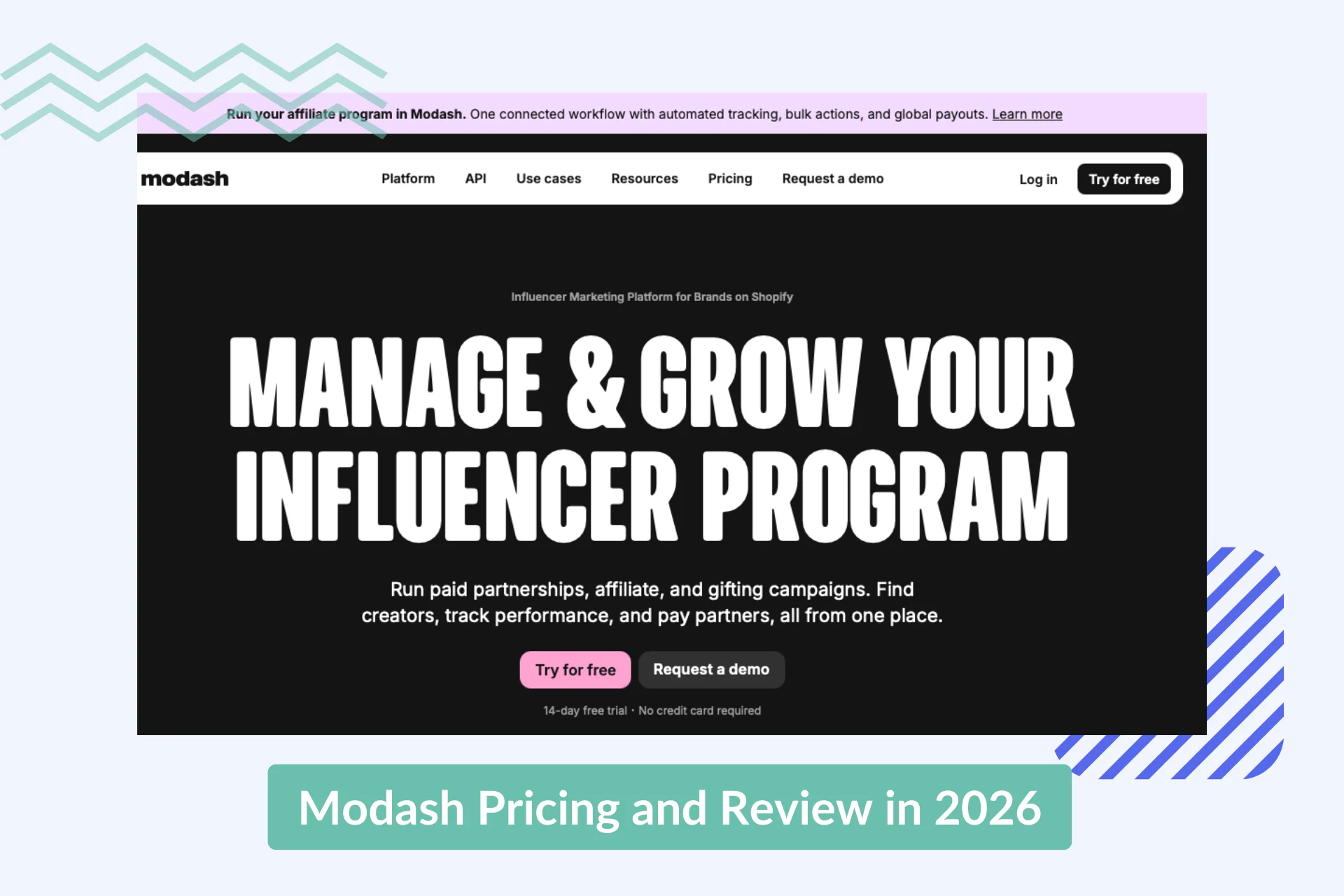
Modash pricing starts at $199/month on annual billing and $299/month month-to-month, with a Performance tier at $499/$599 and a quote-based Enterprise plan. That's mid-market for influencer marketing software — cheaper than GRIN or CreatorIQ, pricier than entry-level tools like Click Analytic or Social Cat.
In this review, we cover Modash's pricing tiers, standout features, real user feedback, and whether it's worth it for your team. We'll also flag the limits that aren't obvious on the pricing page but matter once you're actually using the platform.
If you're a brand running or scaling an influencer program and weighing your software options, this breakdown is for you.
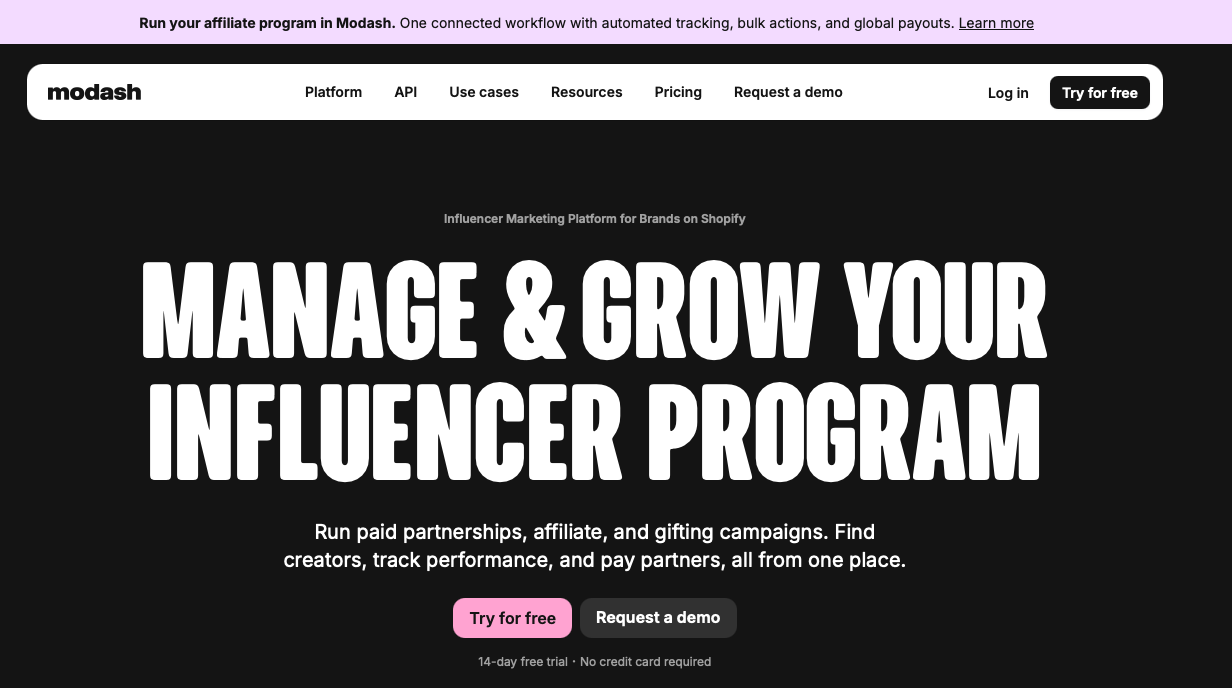
Modash is an influencer marketing platform built for brands that want to run discovery, outreach, gifting, payments, and campaign tracking in one place. Founded in 2018 and headquartered in Estonia, it works with brands including Google, Victoria's Secret, NordVPN, and Airbnb, and is best known for its 350M+ creator database covering Instagram, TikTok, and YouTube. The platform leans heavily into Shopify, with a native integration that ties creator activity directly to sales data — which is why you'll see it most often inside ecommerce stacks.
Modash uses a transparent two-tier public model with a third Enterprise plan that requires a demo. Annual billing saves you roughly $100/month on Essentials and $100/month on Performance. There's a 14-day free trial on both public tiers — no card required.
This is the entry tier, built for small teams running up to 100 active creator partnerships. It includes 2 team members, 300 profile analyses per month, 150 email unlocks, and 100 tracked creators. The 300-profile cap is the constraint that bites first — if your team does heavy discovery, you'll burn through it in the first two weeks of any given month.
Designed for brands scaling beyond ~100 creators. Bumps you to 5 team members, 800 profile analyses, 400 email unlocks, and 250 tracked creators. This is where most growing D2C brands end up after a few months on Essentials.
Quote-based. Public estimates from G2 and review sites put it around $14,700/year and up, depending on team size, profile limits, and API access. Includes SSO, expanded seats, and API access — features that aren't available on lower tiers regardless of usage.
Hidden costs to flag: Annual billing means paying $2,388 upfront for Essentials or $5,988 for Performance. Payment processing for creator payouts is handled through the platform but carries its own fees on top of subscription. And API access is locked behind Enterprise — meaning if you need data piped into your own systems, you're moving to the custom tier regardless of how small your team is.
Modash holds a 4.9/5 on G2 across 15+ reviews and a similar score on Capterra, which is rare in this category. The praise is consistent: discovery filters, audience data accuracy, Shopify integration, and a support team that ships requested features quickly.
The frustrations are equally consistent. One G2 reviewer noted that "the inbox and emailing functionalities are pretty limited currently," and another shared that "the contracting phase is still a bit manual — I currently have to draft agreements externally." Multiple Shopify App Store reviews echo the same thing: discovery and payments feel seamless, contracts and outreach feel like a separate workflow.
Broader sentiment on LinkedIn and Reddit lines up with this: Modash is what marketers recommend when someone asks "what's the best discovery tool under $500/month?" — but the same people will tell you to keep your contract and outreach workflow somewhere else for now.
Modash is genuinely the right pick for D2C and ecommerce brands — particularly Shopify stores — that have already validated influencer marketing as a channel and want to scale discovery, audience analysis, and content tracking in one place. If you're running 50 to 250 active creator partnerships and your stack already includes Shopify, the Performance plan at $499/month is well-priced for what you get.
It starts to fall short for two specific groups. The first is brands that need heavy outreach and contract management as a primary workflow — you'll outgrow Modash's messaging tools quickly and probably end up running outreach in a dedicated CRM anyway. The second is brands not on Shopify — without the native sales integration, a big chunk of Modash's ROI story disappears.
Budget-wise, Modash makes sense in the $200-$600/month range. Below that, tools like Click Analytic, Social Cat, or Influencer Hero's entry plans cover discovery basics at lower cost. Above that, GRIN and CreatorIQ get you full enterprise CRM depth that Modash doesn't currently match.
For Shopify D2C brands running creator discovery at scale, yes — Modash is one of the best-value platforms in the category. The 350M database, audience analysis, and Shopify integration deliver real workflow gains, and the public pricing means you can budget without negotiating. The 4.9/5 G2 rating is real.
Where Modash falls short is the parts of the workflow that aren't discovery. If contracting, structured outreach, or non-Shopify ecommerce integration are central to how you run influencer marketing, you'll feel the gaps within the first month. And if you don't need the level of discovery depth Modash provides, you're probably overpaying — there are cheaper tools that cover the basics.
Modash is a strong, well-priced platform for the specific job it's built for: helping ecommerce brands find creators, vet their audiences, run campaigns, and tie that back to Shopify sales data. The two main weaknesses — outreach UI and no contract builder — are real, but the team is shipping fast and the core product is solid.
That said, software isn't the only way to run an influencer program. If the campaign management, outreach, and contracting overhead is the part you'd rather not deal with at all, there's a different model worth looking at. Creator Hero is a storefront platform where 55,000+ creators sign up to sell brand products on commission (20–50%). There's no upfront campaign spend, no outreach, no contracts to manage — creators pick your products, build storefronts, and drive sales. You focus on product and scaling; they handle the selling.
Let the creators do the selling for you, so you can focus on developing new products and scaling your brand. Explore Creator Hero for brands and book a free demo to see how it works.


_logo.svg.png)


