Boksi Pricing & Review 2026: Features, Costs & Verdict
Boksi pricing starts at roughly €99/month for the entry UGC subscription, but that number alone won't tell you what a campaign costs. Boksi runs on a subscription-plus-credits model, and the credits, creator payouts, and content purchases all sit on top of the plan fee.
In this review, we cover Boksi's pricing tiers, standout features, real user feedback, and whether it's worth it for your team.
If you're a brand running or scaling a creator program in Europe and evaluating your software options, this breakdown is for you.
Quick Summary
Best for: Brands selling in Finland or Germany that want UGC volume plus long-term influencer collabs in one platform
Starting price: From ~€99/month (UGC Intro tier) plus required credits
Free trial: No — free demo only
G2 rating: No public rating; Boksi has almost no verified third-party reviews
Our verdict: Strong UGC workflow and genuinely good content output, but the two-market limit and credit-based pricing make it a hard sell outside the Nordics and DACH
What Is Boksi?
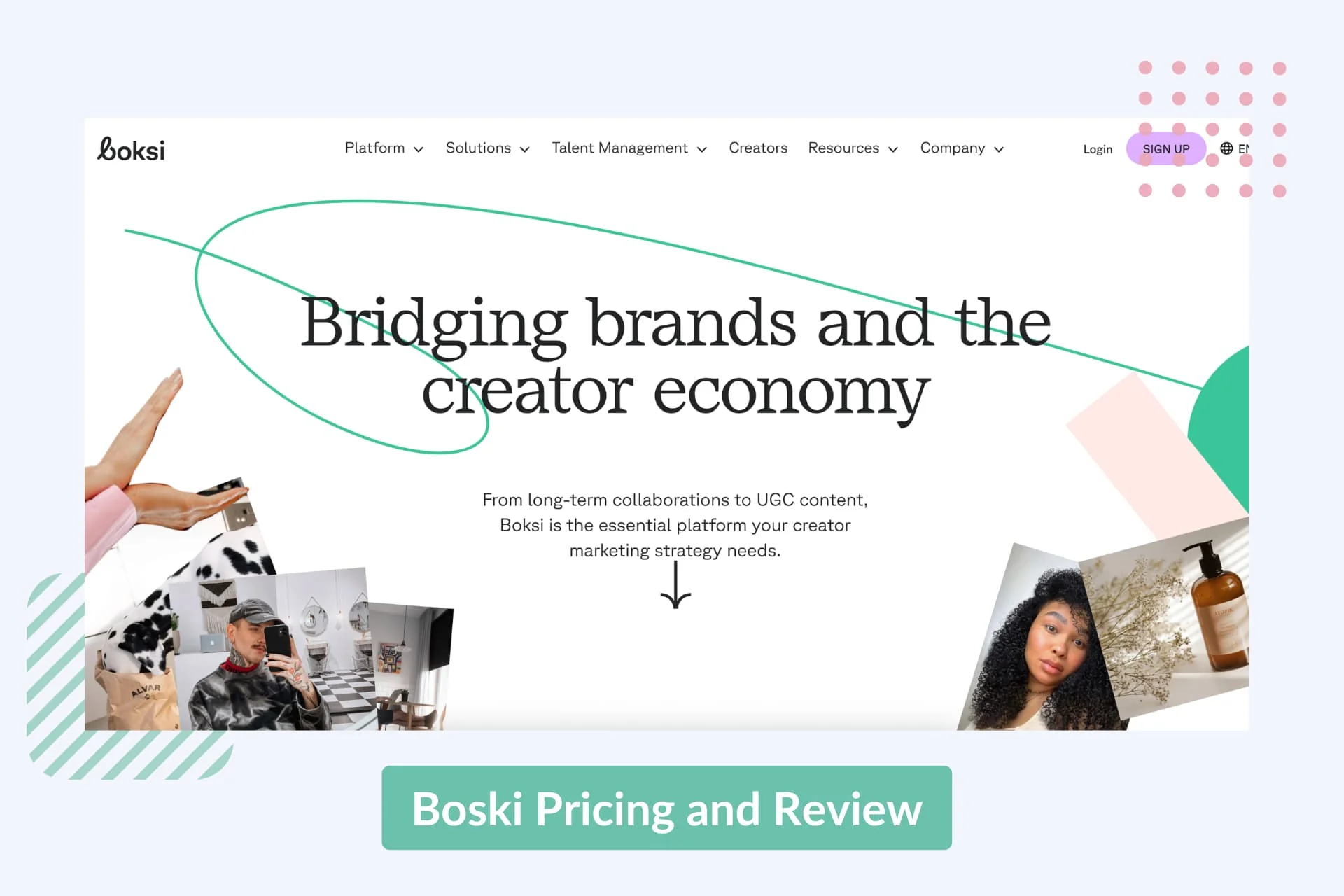
Boksi is a Finnish creator marketing platform that connects brands with vetted UGC creators and influencers, handling briefing, negotiation, contracting, content approval, payments, and reporting in one place. It was founded in Helsinki, opened a second office in Hamburg, and raised a €7 million Series A in late 2023 led by 3TS Capital Partners with Nexit Ventures.
The company reports 27,000+ creators in its network, 500,000+ photos and videos produced, 3,500+ campaigns run, and over €15 million paid out to creators. Its client list skews toward established European brands — Lumene, Kärcher, Tikkurila, Luhta, Polar, and Bob W.
The positioning is worth understanding before you evaluate the pricing: Boksi sells two products under one platform. One is UGC content sourcing, the other is long-term influencer collaboration management.
Boksi Key Features
Creator Discovery Tool
Boksi lets you filter over 250 million TikTok and Instagram profiles by follower count, audience demographics, location, and performance data. It's a proper discovery database, not just a roster of creators who signed up.
The catch is that discovery breadth doesn't equal activation breadth. You can find profiles anywhere, but Boksi's campaign delivery is built around its Finnish and German creator networks.
AI brief builder
You feed in your brand requirements, product details, and campaign goals, and Boksi generates a creator-ready brief. Brands in Boksi's own case studies consistently point to briefing as the thing that keeps output on-brand.
This is one of the more practical uses of AI in this category. Bad briefs are the single most common reason UGC comes back unusable, and removing that friction genuinely shortens the cycle.
Buy-what-you-want UGC model
Creators apply to your brief, produce content, and you browse what comes in and purchase only the pieces you actually want. Everything you buy comes with eternal, full usage rights across paid ads, email, social, and web.
That rights structure is a real advantage. Plenty of platforms in this space license content for 6 or 12 months and charge again for renewal, so unrestricted perpetual rights removes a recurring cost most teams forget to budget for.
Long-term influencer collaboration management
Outreach, briefing, fee negotiation, posting date approval, contracting, and payments all run through the platform. Boksi is explicit that this side of the product is built around yearly contracts rather than one-off posts.
That's a deliberate philosophy, not a limitation — they're betting that repeated creator partnerships outperform one-off activations. It does mean the influencer product is a poor fit if you want to test a handful of creators and walk away.
First-party reporting
Campaign reporting pulls engagement rate, CPM, and conversion data directly from Instagram and TikTok rather than scraping estimates. Growth and Premium tiers add monthly curated reports built by Boksi's team.
The gap is ecommerce attribution. Boksi reports on social performance well, but you won't find the Shopify-level revenue tracking that platforms like GRIN or Influencer Hero build their reporting around.
Boksi Pricing
Boksi runs two separate pricing ladders — one for influencer marketing, one for UGC — and neither publishes hard numbers in plain text. The figures live inside images on the pricing page, and Boksi states that prices vary by service model, campaign count, creator count, content volume, and features.
UGC Intro — from ~€99/month plus credits
The entry point for brands testing UGC sourcing. You get platform access, the ability to post briefs, and the buy-what-you-use content model, with credits purchased on top of the subscription to cover actual content.
The main constraint is that you're largely self-serve here. No dedicated CSM, and the support layer that makes Boksi genuinely easy is reserved for higher tiers.
UGC Essential — from ~€199/month plus credits
The middle tier, aimed at brands producing content on a recurring basis rather than testing. More platform capability and higher credit allowances, still without full service support.
This is where most mid-market brands would realistically land if they're producing content monthly.
UGC Premium — quote-based, plus credits
The full package: dedicated Customer Success Manager, Creator Discovery Tool access, AI brief tools, and monthly curated reports. This is the tier where Boksi functions as a managed service with software attached.
If the appeal of Boksi is the team support that shows up in every case study, this is the tier you're actually buying.
Influencer Core, Growth, and Enterprise — quote-based
The influencer ladder mirrors the UGC one. Core is the entry platform tier, Growth adds the CSM, Creator Discovery Tool, AI briefing, and monthly reports, and Enterprise unlocks everything with a dedicated CSM and custom scope.
Boksi doesn't publish figures for any of the three. You book a demo and get a proposal, which the company says it turns around within one business day.
Flag these hidden costs:
Credits sit on top of every UGC subscription, and Boksi doesn't publish a universal per-video or per-asset figure — meaning your all-in cost isn't modelable before you talk to sales. Creator payouts are separate again: UGC creators earn from €150 per item sold, and influencers set their own rates with Boksi taking a 10% commission on collaborations.
Revision policy isn't disclosed publicly either. And on the influencer side, the yearly contract structure means you're committing for twelve months before you've seen a single deliverable.
Boksi Pros & Cons
Pros
- Perpetual full usage rights on every purchased asset. No license expiry, no renewal fees, usable across paid ads and owned channels indefinitely — a meaningful cost saving versus platforms that license content in 6- or 12-month windows.
- You only pay for content you approve. The UGC model lets creators submit, then you buy the pieces that work. Compare that to paying a fixed per-video rate and hoping the output lands.
- Genuine service layer on higher tiers. The CSM and campaign support aren't token features — brands in Boksi's case studies repeatedly credit the team's responsiveness as the reason the platform works for them.
- Strong content quality in the Nordic and DACH markets. Boksi vets creators rather than running an open marketplace, and it shows in the output.
- Serious discovery database. 250 million+ TikTok and Instagram profiles with demographic and performance filtering is competitive with dedicated discovery tools.
Cons
- Campaigns only run in Finland and Germany. Boksi states this directly. If you're a US, UK, or global D2C brand, this is disqualifying regardless of how good the platform is.
- Credit-based pricing you can't model in advance. A €99 subscription floor tells you almost nothing about what 10 videos a month will cost. You need a sales conversation to get a real number.
- Yearly contracts on the influencer product. Twelve-month commitment before you've validated whether the creator pool converts for your category.
- Almost no independent review coverage. Boksi has a Capterra listing and a G2 profile with essentially no verified reviews behind them. Every testimonial you'll find is published by Boksi.
- Revision terms aren't disclosed. If your team iterates heavily on creative, you're negotiating that scope deal by deal.
What Boksi Users Say
This is where Boksi gets harder to assess than most platforms in this category. It has profiles on G2 and Capterra, but neither carries a meaningful volume of verified reviews, so there's no aggregate rating worth quoting and no pattern of independent complaints to point to.
What does exist is a set of detailed brand case studies published by Boksi itself. The Paid Social Team Lead at waterdrop® described their polished in-house content underperforming UGC in social ads, and credited Boksi with sourcing authentic content without burning internal time on creator sourcing. Lumene's Global Head of Digital Content said she'd recommend Boksi, pointing to consistent content quality from the creators they worked with.
Treat those as directional rather than independent — they're vendor-published, and no brand appears in a case study because the experience was mediocre. The recurring theme across them is worth noting anyway: brands praise the team and the briefing process more often than they praise the software itself, which tells you where Boksi's real value sits.
Who Is Boksi Best For?
Boksi makes sense for mid-market and enterprise brands selling into Finland or Germany that need a steady flow of UGC for paid social and want long-term creator relationships rather than one-off posts. The client roster — consumer goods, beauty, home, sportswear, consumer tech — reflects exactly that profile.
It's a particularly good fit if your team is small and you want the platform's CSM to carry some of the operational load. On Premium or Growth, Boksi behaves closer to a managed service than a self-serve tool, and that's a legitimate reason to pay for it.
It falls short for anyone selling outside those two markets, full stop. It also isn't the right choice for performance teams that need to iterate fast on creative, model cost per asset before committing, or attribute revenue at the Shopify level.
On budget: the ~€99–199/month entry tiers look accessible, but once credits and creator payouts stack on top, realistic monthly spend lands well above the subscription line. If you're working with under €1,000/month total creator budget, a self-serve marketplace will stretch further.
Is Boksi Worth It?
Yes, if you're a European brand with Finnish or German customers and you want a vetted creator pool plus a team that helps you run the program. The perpetual usage rights, the pay-for-what-you-approve UGC model, and the briefing tooling are real advantages, and the content quality holds up.
No, if you're anywhere else. The two-market restriction isn't a soft limitation you can work around, and the pricing opacity is a genuine friction point — a €99 headline that requires a sales call to become a real number is a harder sell in 2026 than it was three years ago, when most competitors published per-video rates.
Boksi Alternatives
If Boksi's geographic limits or credit-based pricing don't work for you, here are five alternatives worth a look — each solving a different gap.
Insense
A campaign-focused UGC and influencer platform with strong Meta and TikTok ad integration, including creator whitelisting for paid amplification. Plans typically start around $500/month with creator payouts billed separately. Brands pick it over Boksi for US and global market coverage and the ability to push creator content straight into paid social as spark ads.
Influee
A UGC platform with roughly 140,000 creators across 24 countries and transparent per-video pricing, generally in the €79–95 range depending on market. It includes unlimited revisions as standard. The reason to choose it over Boksi is simple: you can model your cost per video before you commit, and you're not locked to two countries.
Influencer Hero
An all-in-one influencer marketing platform covering creator discovery across Instagram, TikTok and YouTube, an influencer CRM, automated outreach and follow-ups, campaign management, affiliate and gifting tracking, payments, and reporting. Pricing is demo-based.
It's the pick over Boksi for brands that want to own the whole program end to end — running outreach at volume, tracking affiliate revenue, and managing hundreds of creator relationships in one CRM rather than relying on a platform's own creator pool and its team.
Modash
A discovery-first tool with a database of 250M+ creator profiles and no geographic restriction on who you can find and contact. Plans start around $199/month. Choose it over Boksi if you want to source creators globally and handle outreach yourself instead of paying for a service layer.
GRIN
A creator management platform built for ecommerce, with deep Shopify integration, product seeding workflows, and affiliate revenue attribution. Pricing is quote-based and lands in the enterprise range. It's the better option if your priority is tying creator activity directly to revenue rather than sourcing content.
Final Thoughts
Boksi is a well-built platform doing something specific well: sourcing quality UGC from vetted creators in Finland and Germany, with a service layer that takes real work off your team's plate. The perpetual usage rights and the buy-only-what-you-approve model are genuinely brand-friendly. The limitations are equally clear, two markets, credit-based pricing you can't calculate in advance, and yearly contracts on the influencer side.
If the campaign management overhead is the part you'd rather avoid entirely, there's a different model worth considering. Instead of briefing, negotiating, and paying creators to produce content, Creator Hero connects your brand with creators who sell your products through commission-based storefronts, 20–50% commission, no upfront campaign spend, and no subscription-plus-credits math to model. Plans run Free, Pro at $19/month, and Premium at $65/month, with 55,000+ brands already in the directory.
Let the creators do the selling for you, so you can focus on developing new products and scaling your brand. Explore Creator Hero for brands or book a free demo to see how it works.


.svg)


%201.png)


_logo.svg.png)


