HypeAuditor Pricing & Review 2026: Features, Costs & Verdict
HypeAuditor pricing starts at $299/month on annual billing for the Basic plan — and that's the floor, not the average. If you need advanced discovery filters, recruitment tools, or higher usage limits, expect to land on the Pro plan at $499/month or move into custom Enterprise pricing.
In this review, we cover HypeAuditor's pricing tiers, standout features, real user feedback, and whether it's worth it for your team.
If you're a brand running or scaling an influencer program and trying to figure out where HypeAuditor fits in your stack, this breakdown is for you.
Quick Summary
Best for: Brands and agencies that need deep audience validation and fraud detection before committing campaign budgets
Starting price: $299/month (Basic, annual billing)
Free trial: By request only — but 40+ free standalone tools are publicly available
G2 rating: 4.6/5 (248+ reviews)
Our verdict: Best-in-class for audience quality scoring and discovery, but reporting depth and pricing transparency don't match the brand price tag.
What Is HypeAuditor?
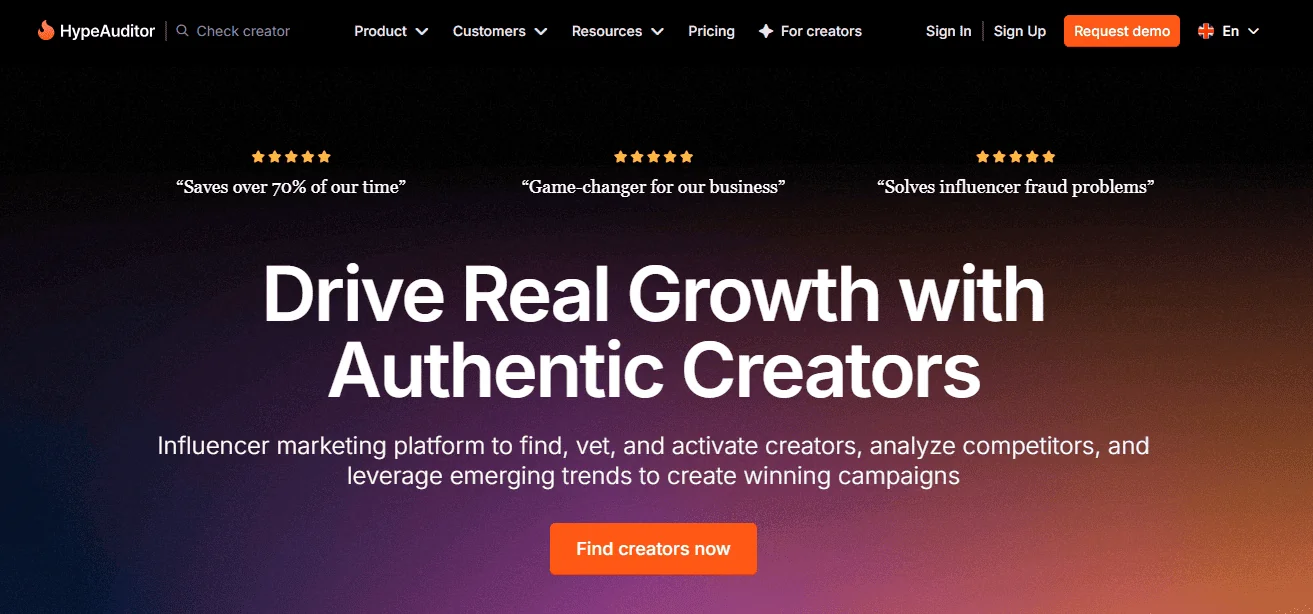
HypeAuditor is an influencer intelligence platform built around audience authenticity. It covers discovery, analytics, CRM, and campaign management across Instagram, TikTok, YouTube, X, and Twitch — but its real reputation comes from its fraud detection and Audience Quality Score, which marketers use to validate creators before sending budget their way.
The platform claims a database of over 205 million influencer accounts, and its typical buyer is a mid-market to enterprise brand or agency that treats audience verification as a non-negotiable step.
HypeAuditor Key Features
• Influencer Discovery with Audience Quality Score. Search creators by audience demographics, engagement rate, niche, and authenticity score. The catch: on the Basic plan, you only get limited discovery filters. AI Search and Account Quality Score filtering are gated behind higher tiers.
• Account Analytics. Pull detailed audience breakdowns for any influencer — country and city distribution, age, gender, language, interest categories, and follower growth history. This is where HypeAuditor consistently outperforms cheaper tools. The depth is real, but the interface assumes you're comparing creators one at a time, not running side-by-side audits at scale.
• CRM (My Network). Track relationship status, communications, and contracts with creators you've worked with. Functional, but not the reason people buy HypeAuditor — reviewers describe it as serviceable rather than best-in-class, and templates can't be deleted, which becomes a real annoyance as teams grow.
• Campaign Management. Run outreach, manage approvals, track deliverables, and report on performance from one place. Solid for moderate volume, but reviewers note the campaign timeline view isn't intuitive and reporting has to be exported to spreadsheets for anything beyond surface-level analysis.
• Market Analysis & Competitor Insights. Industry reports and competitor benchmarking show how rival brands work with creators in your niche. Useful for strategy decks, but mostly bundled into higher tiers — small teams on Basic won't see the full value here.
HypeAuditor Pricing
HypeAuditor doesn't publish a full pricing page, but they do disclose entry-level pricing for Basic and Pro on annual billing. Everything beyond that is quote-based.
Basic — $299/month (annual billing)
Entry tier aimed at small teams or those starting out with influencer marketing. You get access to the core modules — Discovery, Analytics, CRM, Campaign Management — but with limited filters and usage caps. Notably, AI Search and the Account Quality Score filter aren't included, which means you're using a watered-down version of HypeAuditor's most-talked-about feature.
Pro — $499/month (annual billing)
Designed for growing teams that need the full discovery experience. Unlocks more advanced audience filters, higher usage limits, and broader analytics access. This is realistically where most serious users land, because the Basic plan limits feel restrictive once you're vetting more than a handful of creators per week.
Enterprise — Custom pricing
Tailored to agencies and large brands running multiple campaigns across teams. Includes full discovery filters, market analysis reports, recruitment tools, additional seats, API access, and dedicated support. Pricing requires a sales call — no public estimates, and contracts are typically annual, with the best rates tied to two-year commitments.
Hidden costs to flag:
• The most competitive pricing requires a longer-term commitment (often two years), which limits flexibility if your needs change.
• Adding seats beyond your plan's allowance increases cost — teams that grow mid-contract end up renegotiating.
• The free trial isn't standard — it's granted case-by-case after a sales conversation, so you can't just sign up and test the platform.
• Several features that feel like they should be standard (advanced filters, AI search) are tier-gated, so the effective starting cost for most teams is $499/month, not $299.
HypeAuditor Pros & Cons
Pros
• Best-in-class audience authenticity scoring. The fraud detection and audience quality data is genuinely deeper than what most competitors offer, and it's the main reason teams stay even when they grumble about pricing.
• Intuitive interface with minimal onboarding. Reviewers consistently say the UI is easy to navigate and they were productive on day one — a real advantage for teams that don't have time for week-long platform training.
• Strong customer support. G2 ratings put support at 9.2/10, and users frequently mention the team is responsive and willing to ship custom fixes for paying clients.
• Wide platform coverage. Instagram, TikTok, YouTube, X, and Twitch are all covered from one dashboard, which is broader than several competitors who started Instagram-only.
• Free tools as a sandbox. The 40+ free tools (fake follower checker, engagement rate calculator) let you sample HypeAuditor's data quality before paying — useful even if you're not ready to commit.
Cons
• Pricing is high and not transparent. $299/month is the floor, real-world spend is closer to $499+, and Enterprise pricing requires a sales call. Multiple G2 reviews flag cost as the main drawback.
• Static reporting that forces spreadsheet exports. The dashboard is good for browsing but limited for analysis — reviewers note they have to export data to spreadsheets to do anything beyond what's displayed.
• Inconsistent TikTok data. Several users have flagged number anomalies and errors specifically on TikTok metrics, which matters more every year as budgets shift to short-form.
• Key features are tier-gated. The AI Search and Account Quality Score filters — features that drive purchase decisions — aren't included in the entry plan, which makes the $299 tier feel like a teaser.
• Annual contract pressure. The best pricing comes with long commitments, and teams whose needs shift mid-term have to absorb unused capacity or renegotiate.
What HypeAuditor Users Say
HypeAuditor holds a 4.6/5 rating on G2 across 248+ reviews — a strong score, and most of the praise focuses on the depth of audience data, the platform's ease of use, and the responsiveness of customer support. The criticism is also consistent and worth taking seriously: pricing, reporting limitations, and data accuracy on TikTok come up repeatedly.
The flip side shows up just as often. "The reporting dashboard is static, so for more in-depth data analysis, you have to export the data into spreadsheets," one user shared on G2, and another flagged that "for TikTok, sometimes it gave some number anomalies or straight error."
Smaller teams on review forums and LinkedIn also tend to mention that pricing puts HypeAuditor out of reach until they're running a meaningful program — it's not a platform you grow into casually.
Who Is HypeAuditor Best For?
HypeAuditor is a strong fit for mid-market to enterprise brands and agencies whose influencer strategy depends on audience authenticity — beauty, fashion, lifestyle, fintech, anywhere where reaching real, qualified audiences is the whole point. If your team is committing $50K+ to a single campaign, the fraud detection alone justifies the spend.
It starts to fall short for small D2C brands and early-stage teams. At $299–$499/month with most useful filters tier-gated, and with reporting that pushes you back to Excel for deeper analysis, it's hard to justify if you're running a few creators a month or testing influencer marketing for the first time. Teams in that range will get more for their money from cheaper discovery tools or from creator-driven sales models that don't require campaign software at all.
The budget sweet spot for HypeAuditor is brands spending $5K–$15K+/month on influencer marketing, with at least one dedicated person managing the program. Below that, the platform is overbuilt for the use case.
Is HypeAuditor Worth It?
For the right brand, yes. If your buying decision hinges on audience authenticity and you're running an active program where vetting creators correctly saves you from wasted budget, HypeAuditor's depth genuinely justifies the price. The Audience Quality Score is the strongest piece, and the broader analytics depth is what keeps reviewers loyal even when they complain about cost.
If you're a small team, a young brand, or you mainly need execution and tracking rather than deep audience validation, it's expensive for what you'll actually use. Most of the headline features sit in tiers above $299, the reporting will push you to spreadsheets anyway, and the contract length limits your flexibility. There are cheaper tools that handle discovery, and there are different go-to-market approaches that skip campaign management altogether.
Final Thoughts
HypeAuditor delivers on its core promise — deep audience analysis, fraud detection, and a clean interface that doesn't fight you. The trade-offs are real: pricing is high for what you get at the entry tier, reporting could be more flexible, and TikTok data has some consistency issues to keep an eye on. For brands that need authenticity verification at scale, it earns its place. For everyone else, the math gets harder.
If managing campaigns, vetting creators, and chasing reporting feels like more overhead than your team can carry, there's a different model worth looking at. Creator Hero connects brands with 55,000+ creators who sell your products through their own commission-based storefronts — no upfront campaign spend, no audience-quality-score evaluations to run, no quarterly contract negotiations.
Let the creators do the selling for you, so you can focus on developing new products and scaling your brand. Explore Creator Hero for brands or book a free demo to see how it works.


.svg)


%201.png)


_logo.svg.png)


