Tarification et avis Embold 2026 : Fonctionnalités, coûts et verdict
La tarification Embold commence à $299/mois pour le plan Starter et $599/mois pour Pro, avec une réduction de 20% sur la facturation annuelle ($239 et $479 respectivement). Les campagnes gérées sont devis sur demande, et le site d'Embold affiche des programmes mensuels à partir d'environ $3 000 et des activations de campagne à partir de $5 000.
Dans cet avis, nous couvrons les niveaux de tarification d'Embold, ses fonctionnalités phares, les retours d'utilisateurs réels, et si c'est fait pour votre équipe. Nous signalerons aussi les points qui importent vraiment une fois que vous lancez des campagnes — y compris les 5% de frais de service de campagne qui ne figurent pas au prix affiché.
Si vous êtes une marque qui lance ou développe un programme d'influenceurs et que vous pesez vos options logicielles, cette analyse est pour vous.
Résumé rapide
Idéal pour : Les marques et agences canadiennes qui veulent un roster de créateurs locaux vérifiés, avec ou sans équipe gérée
Prix de départ : $299/mois (Starter, facturation mensuelle) ou $239/mois facturé annuellement
Essai gratuit : Pas d'essai formel, mais les marques peuvent créer un compte gratuit pour explorer
Note G2 : 5.0/5 — à partir de 4 avis seulement
Notre verdict : L'option la plus solide au Canada pour l'approvisionnement en créateurs locaux, mais la couche plateforme est légère et il n'y a pas d'intégration de commerce électronique pour lier les campagnes au chiffre d'affaires
Qu'est-ce qu'Embold ?
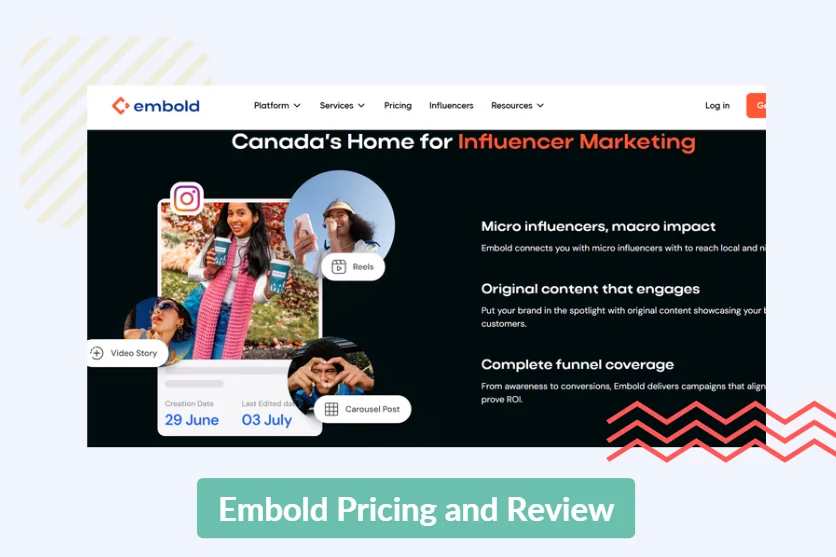
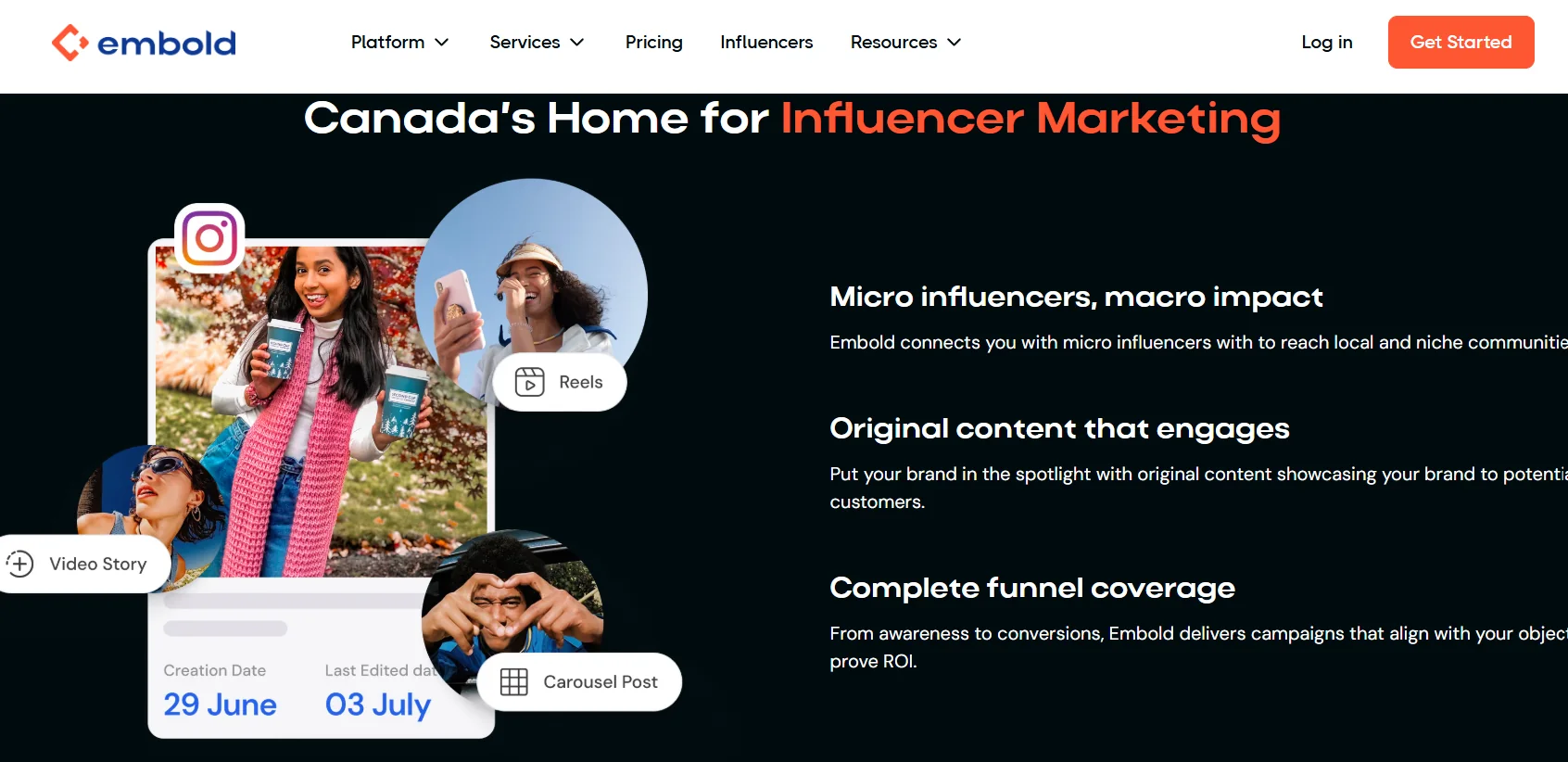
Embold est une entreprise de marketing d'influenceurs basée à Calgary qui gère un roster curé de 9 000+ créateurs canadiens vérifiés, avec accès à environ 30 000 autres à travers le pays. Elle vend deux choses : une plateforme en libre-service que les marques gèrent elles-mêmes, et un service entièrement géré où l'équipe d'Embold s'occupe de l'approvisionnement, des contrats, de l'examen du contenu et des rapports.
Le positionnement est volontairement étroit. Tandis que la plupart des plateformes concurrencent sur la taille de la base de données et la portée mondiale, Embold concurrence sur la pertinence canadienne — créateurs locaux, conformité locale, connaissance du marché local. Elle rapporte que 500+ marques et agences ont lancé des programmes par son intermédiaire, notamment BMO et Longo's.
Les types de campagnes couvrent les campagnes rémunérées, les envois de produits, l'UGC et le whitelisting, ce qui la rapproche des plateformes de gifting à service complet plutôt que d'un outil de découverte pur.
Fonctionnalités clés d'Embold
Découverte d'influenceurs dans un roster curé. Chaque créateur sur Embold a opté pour y participer et recherche activement du travail avec des marques, filtrable par démographie du créateur, démographie de l'audience et métriques sociales. C'est un vrai avantage sur les bases de données récupérées où la moitié des profils ne répondent pas. Le compromis : 9 000 créateurs c'est petit comparé à un index de 350M profils, et vous êtes limité au Canada.
Tarification fixe et transparente des créateurs. L'algorithme d'Embold fixe un tarif équitable pour chaque créateur qui est visible des deux côtés, donc pas de négociation de tarif. Pour les équipes qui détestent marchander, c'est un vrai gain de temps. Pour les équipes habituées à négocier à la baisse, cela supprime un levier.
Gestion du roster. Vous obtenez une page d'accueil de marque pour recruter vos propres créateurs — clients, fans existants, candidats — et les gérer aux côtés du réseau d'Embold. C'est la chose la plus proche d'un CRM qu'Embold a, et c'est la fonctionnalité que les marques citent le plus quand elles restent.
Annonces en whitelist et amplification payante. Embold supporte l'exécution d'annonces payantes par les comptes de créateurs, ce que la plupart des plateformes à ce prix ne font pas. Disponible en libre-service et considérablement développé sur les campagnes gérées.
Gestion de campagne et rapports. Instagram, TikTok et YouTube s'intègrent directement pour la collecte automatisée de données. Les rapports couvrent la performance des campagnes et les rémunérations des influenceurs, mais il n'y a pas d'attribution de commerce électronique — pas de connexion Shopify, WooCommerce ou Magento pour lier les publications aux ventes.
Tarification Embold
Embold publie sa tarification en libre-service, ce que la plupart de la catégorie ne fait pas. Notez qu'Embold est une entreprise canadienne et les annonces tierces rapportent couramment ces chiffres en CAD.
Starter — $239/mois (annuel) ou $299/mois (mensuel)
Accès illimité au roster de 9 000+ créateurs, filtres de découverte, gestion du roster et générateur de campagne. Vous pouvez lancer des campagnes rémunérées, des envois de produits, UGC et whitelisting, et vous contrôlez toute la rémunération et la négociation. C'est entièrement autogéré — pas d'onboarding, pas de gestionnaire de succès, pas d'aide à l'approvisionnement.
Pro — $479/mois (annuel) ou $599/mois (mensuel)
Tout dans Starter plus un gestionnaire de succès client dédié, assistance au recrutement d'influenceurs, onboarding gratuit, support stratégique de campagne 1-à-1, et facturation de campagne. La principale raison de passer à ce niveau est l'aide humaine, pas le logiciel — l'ensemble des fonctionnalités est presque identique.
Services gérés — Devis personnalisé
L'équipe d'Embold s'occupe de tout : stratégie, approvisionnement, contrats, examen du contenu et rapports. Le site cite des programmes mensuels à partir d'environ $3 000 et des activations de campagne à partir d'environ $5 000, bien que ses pages de marketing plus récentes affichent des planchers plus élevés ($4 000/mois et $10 000 par activation). La facturation est basée sur les étapes pour les campagnes ponctuelles et mensuelle pour les programmes continus.
Attention aux frais de service.
Les deux tiers en libre-service appliquent des frais de service de campagne de 5 % en plus de votre abonnement, plus les frais standard de traitement des cartes de crédit sur les paiements aux influenceurs. Sur une dépense de campagne de 20 000 $, cela représente 1 000 $ supplémentaires qui n'apparaissent nulle part sur la page tarifaire.
Il n'y a pas de durée minimale pour les campagnes en libre-service ou gérées, ce qui est inhabituel et franchement avantageux — la plupart des concurrents à ce prix exigent 12 mois. Pour contextualiser où se situent les 299 $ à 599 $/mois sur le marché plus large, notre examen des tarifs de Modash couvre l'équivalent le plus proche axé mondialement.
Avantages et inconvénients d'Embold
Avantages
Aucun engagement contractuel. Les campagnes en libre-service et gérées fonctionnent sans durée minimale. Dans une catégorie où les engagements annuels de 12 mois sont standard, c'est le point le plus favorable aux marques chez Embold.
Tarification publique et transparente. Deux tiers, chiffres clairs, un vrai tableau comparatif. Vous pouvez établir un budget sans appel commercial.
Créateurs réellement vérifiés et consentants. Tout le monde dans le répertoire souhaite travailler avec des marques et opère selon un accord de service avec Embold. Les taux de réponse et les taux d'achèvement le reflètent.
Profondeur canadienne réelle. Si votre marché est le Canada, aucune autre plateforme ne correspond à la densité du répertoire local ou aux connaissances spécifiques au marché.
Whitelisting inclus au niveau d'entrée. L'amplification payante via les poignées de créateurs se trouve généralement derrière une tarification d'entreprise ailleurs.
Inconvénients
Aucune intégration ecommerce. Il n'y a pas de connexion Shopify, WooCommerce ou Magento, ce qui signifie pas de codes de réduction automatisés, pas d'attribution de ventes, pas de suivi du ROI sans feuilles de calcul. La comparaison de G2 elle-même signale ceci comme une fonctionnalité qu'Embold n'a pas et que la plupart des alternatives proposent. Pour les marques D2C, c'est l'obstacle majeur. Si l'attribution de revenus est votre priorité, notre sélection de logiciels d'influenceurs Shopify couvre les plateformes qui le gèrent nativement.
Canada uniquement. Aucune possibilité d'étendre un programme à l'international sans ajouter une deuxième plateforme.
Couche plateforme mince. Pas d'automatisation de prospection, pas de séquençage par email, pas de découverte IA, et profondeur CRM limitée. Un examinateur de G2 a noté que « certaines logistiques de campagne nécessitent toujours un suivi en dehors de la plateforme » lors de l'exécution de plusieurs campagnes simultanément.
Les frais de service de 5 %. C'est divulgué, mais c'est enterré dans un tableau comparatif plutôt que sur la carte tarifaire.
Ce que disent les utilisateurs d'Embold
Embold détient une note de 5.0/5 sur G2 — sur quatre avis. Capterra affiche 5.0/5 sur 11 avis. Les deux chiffres sont techniquement parfaits et fonctionnellement sans signification : l'échantillon est minuscule, et la plupart des avis sont recommandés par le fournisseur avec une incitation nominale associée.
Plus utile est qui les écrit. La grande majorité sont des créateurs, pas des marques — des influenceurs faisant l'éloge des systèmes de notification, de la clarté des campagnes et des délais de paiement. C'est un signal sur où l'énergie produit d'Embold s'est dirigée, mais cela vous dit presque rien sur l'expérience du côté marque.
La poignée d'avis du côté marque sont cohérents sur une chose : les gens. Les examinateurs mettent en avant une gestion de compte proactive, la découverte de créateurs que la marque n'avait pas trouvés elle-même, et l'élimination des allers-retours de coordination. La critique est tout aussi cohérente — des flux de travail qui s'étendent en dehors de la plateforme une fois que vous exécutez plusieurs campagnes en parallèle.
Du côté des créateurs, un examinateur de Capterra a noté que « le processus de paiement n'a pas toujours été transparent, mais j'ai toujours été payé. » D'autres ont signalé des chargements de page lents (Embold recommande Chrome) et voulaient une variété plus large de campagnes. Rien de cela n'est disqualifiant, mais les flux d'approbation à chargement lent et les frictions de paiement finissent par atteindre vos créateurs. Si vous définissez la rémunération sur Starter, où vous contrôlez toute négociation, notre guide des tarifs de rémunération des influenceurs est un repère utile par rapport à l'algorithme à taux fixe d'Embold.
Pour qui Embold est-il le meilleur ?
Embold est un bon choix pour les marques canadiennes exécutant des campagnes de sensibilisation, UGC ou de cadeaux où l'objectif est le contenu et la portée plutôt que les revenus tracés. L'alimentation et les boissons, la beauté, la maison et l'automobile sont autant de catégories où un répertoire local vérifié surpasse une base de données mondiale, car la pertinence est géographique.
C'est aussi un bon choix pour les équipes marketing réduites qui veulent l'exécution gérée sans frais d'agence, et pour les agences servant des clients canadiens qui ont besoin d'une infrastructure de campagne en marque blanche qu'elles n'ont pas à construire.
Là où cela pêche est l'ecommerce D2C. Si votre programme d'influenceurs existe pour générer des ventes traçables, l'intégration de magasin manquante signifie que vous reconstruisez l'attribution manuellement dès le premier jour — et cela s'aggrave, ne s'améliore pas, au fur et à mesure que vous montez en échelle.
En matière de budget, Embold a du sens dans la fourchette de 300 $ à 600 $/mois si vous êtes Canada uniquement et axé sur le contenu. Au-dessus d'environ 2 500 $/mois, vous entrez dans le domaine des services gérés, où vous devriez comparer Embold par rapport aux agences plutôt que par rapport aux logiciels.
Embold en vaut-il la peine ?
Pour une marque canadienne qui cherche des créateurs locaux, sans contrat et une équipe pour gérer vos campagnes, oui. La structure sans engagement minimum a sa valeur dans une catégorie construite sur des verrouillages annuels, et 9 000 créateurs canadiens inscrits est un vrai atout que vous ne pouvez pas reproduire en filtrant simplement une base de données mondiale par pays.
Où ce n'est pas rentable : pour toute marque dont le programme d'influenceurs doit prouver un retour sur investissement. 299 $/mois vous achètent la découverte et la coordination des campagnes, pas l'attribution — et les frais de service de 5 % réduisent l'écart entre Embold et les plateformes qui incluent le suivi du commerce électronique à des prix similaires ou légèrement supérieurs. Ce n'est pas non plus rentable si le Canada n'est qu'un marché parmi d'autres ; vous finirez par payer deux plateformes. Pour voir ce que coûte réellement une tarification nativement orientée vers le commerce électronique, notre analyse des tarifs d'Upfluence couvre l'autre extrémité de ce compromis.
Alternatives à Embold
Si Embold n'est pas la bonne solution — généralement parce que vous avez besoin d'attribution au commerce électronique, d'une portée mondiale ou plus d'automatisation qu'une base de créateurs et un générateur de campagnes — voici cinq alternatives qui méritent le coup d'œil.
1. Modash
Une plateforme axée sur la découverte avec un index de 350 M+ créateurs sur Instagram, TikTok et YouTube, à partir de 199 $/mois annuels ou 299 $/mois mensuels. Les marques la choisissent plutôt qu'Embold quand elles ont besoin de trouver des créateurs n'importe où dans le monde et qu'elles veulent une intégration Shopify native qui lie l'activité des créateurs aux ventes. Le compromis : vous perdez entièrement l'option de service géré.
2. Social Cat
Une marketplace de micro-influenceurs construite autour des candidatures entrantes et du gifting de produits, avec des forfaits de 99 à 299 $/mois et les droits d'utilisation du contenu inclus à tous les niveaux. C'est la chose la plus proche du modèle d'Embold à un prix inférieur — les créateurs vous postulent plutôt que l'inverse. Les marques la choisissent plutôt qu'Embold quand elles sont axées sur le gifting, ont un budget limité et n'ont pas besoin de la spécificité canadienne.
3. Influencer Hero
Une plateforme tout-en-un couvrant la découverte de créateurs sur Instagram, TikTok et YouTube, un CRM pour influenceurs, les relances et prospections automatisées, la gestion de campagnes, le gifting et le suivi des affiliés, les paiements et les rapports. Les tarifs sont publics — Standard à 649 $/mois, Pro à 1 049 $/mois et Business à 2 490 $/mois — vous pouvez donc les comparer à Embold sans appel commercial.
Les marques la choisissent plutôt qu'Embold quand elles veulent le programme complet en un seul endroit avec une véritable attribution des revenus : elle s'intègre à Shopify et WooCommerce, génère automatiquement des codes de réduction et rapporte les ventes générées par les influenceurs, aucune de ces choses qu'Embold ne fait.
4. Upfluence
Une plateforme native du commerce électronique s'intégrant à Shopify, WooCommerce, Magento, BigCommerce et Amazon Attribution, avec des coûts réels commençant autour de 14 000 $/an sur un contrat annuel. Les marques la choisissent plutôt qu'Embold quand la profondeur de l'intégration au magasin est le facteur décisif et qu'elles peuvent accepter l'engagement qu'Embold ne demande pas.
5. Later Influence
Une plateforme d'entreprise associant 15 M+ profils de créateurs avec la publication sur les réseaux sociaux et des services gérés optionnels — le même modèle logiciel-plus-équipe qu'Embold, à une échelle beaucoup plus grande. Les marques la choisissent plutôt qu'Embold quand elles ont besoin de cette structure hybride mais opèrent au-delà du Canada.
Réflexions finales
Embold fait une seule chose mieux que quiconque : mettre les marques canadiennes en face de créateurs canadiens vérifiés, avec ou sans une équipe pour la gérer. Ce que vous n'achetez pas, c'est une plateforme logicielle — la découverte, la base de créateurs et le générateur de campagnes sont compétents, mais il n'y a pas d'intégration au commerce électronique, pas d'automatisation de prospection et aucun moyen de prouver les revenus sans le faire manuellement.
Si vous préférez sauter entièrement la gestion de campagnes — pas d'abonnements, pas de frais de service, pas de négociation des tarifs des créateurs — il y a une approche fondamentalement différente qui vaut le coup d'être considérée. Creator Hero est un générateur de vitrines, pas une plateforme SaaS : 55 000+ marques se connectent avec des créateurs qui vendent leurs produits via des vitrines à commission, gagnant 20–50 % sur ce qu'ils vendent. Pas de dépense de campagne initiale, pas de logiciel à apprendre, pas de problème d'attribution à résoudre.
Laissez les créateurs vendre pour vous, pour que vous puissiez vous concentrer sur le développement de nouveaux produits et l'expansion de votre marque. Explorez Creator Hero pour les marques ou réservez une démo gratuite pour voir comment ça fonctionne.
FAQs
Quel est le coût d'Embold ?
Le plan Starter d'Embold coûte $299/mois facturé mensuellement ou $239/mois facturé annuellement. Le plan Pro est $599/mois mensuellement ou $479/mois annuellement. Les campagnes gérées sont devisées sur mesure, avec des programmes mensuels à partir d'environ $3 000 et des activations de campagne à partir d'environ $5 000. Les deux tiers en libre-service ajoutent des frais de service de campagne de 5 %.
Embold propose-t-il un essai gratuit ?
Il n'y a pas d'essai gratuit formel, mais les marques peuvent créer un compte gratuit pour parcourir la plateforme avant de s'engager. Il n'y a également aucun terme de contrat minimum sur les campagnes en libre-service ou gérées, vous pouvez donc commencer et arrêter mensuellement.
Embold vaut-il le coup pour les petites marques ?
Si vous êtes une petite marque canadienne axée sur le UGC, les cadeaux ou la notoriété, Starter à $239–$299/mois est raisonnable et l'absence de contrat réduit le risque. Si vous êtes une petite marque D2C qui a besoin de suivre les ventes, l'absence d'intégration de commerce électronique vous coûtera plus en travail manuel que ce que l'abonnement économise.
À quoi sert le mieux Embold ?
Sourcer et activer des micro-influenceurs canadiens vérifiés, en libre-service ou entièrement gérés. Il est le plus fort pour les campagnes de contenu et de portée sur un seul marché, et le plus faible pour les programmes de commerce électronique axés sur la performance.
Quelle est une bonne alternative à Embold ?
Modash si vous avez besoin de découverte mondiale et de suivi Shopify avec un budget similaire. Influencer Hero si vous voulez le programme complet — prospection, CRM, affiliation et attribution — sur une seule plateforme avec tarification publique. Pour une comparaison plus large d'options moins coûteuses orientées cadeaux, consultez notre tour d'horizon des alternatives à Social Cat.
Related Posts
The incredible power of team collaboration is evident in the remarkable outcomes it can achieve
Comparaison entre UGC payant et posts sponsorisés ? Voici ce que les marques versent aux créateurs pour chacun, ce que ces honoraires couvrent, et comment les droits d'utilisation modifient le budget.
Tarification d'Influur expliquée : pas d'abonnement pour les marques, frais à l'usage, vrais avantages et inconvénients, et notre avis sur le fait que cette place de marché créateurs vaut le coup en 2026.
Tagbox semble bon marché à $19/mois — mais la fonctionnalité dont la plupart des marques ont vraiment besoin est cachée derrière un devis Enterprise. Voici le détail complet des tarifs et notre verdict honnête.
Build your own business without having to manage all the operational aspects of an e-commerce. Focus on creating content, driving sales and maximise your earnings!


.svg)


%201.png)



_logo.svg.png)


